
 By admin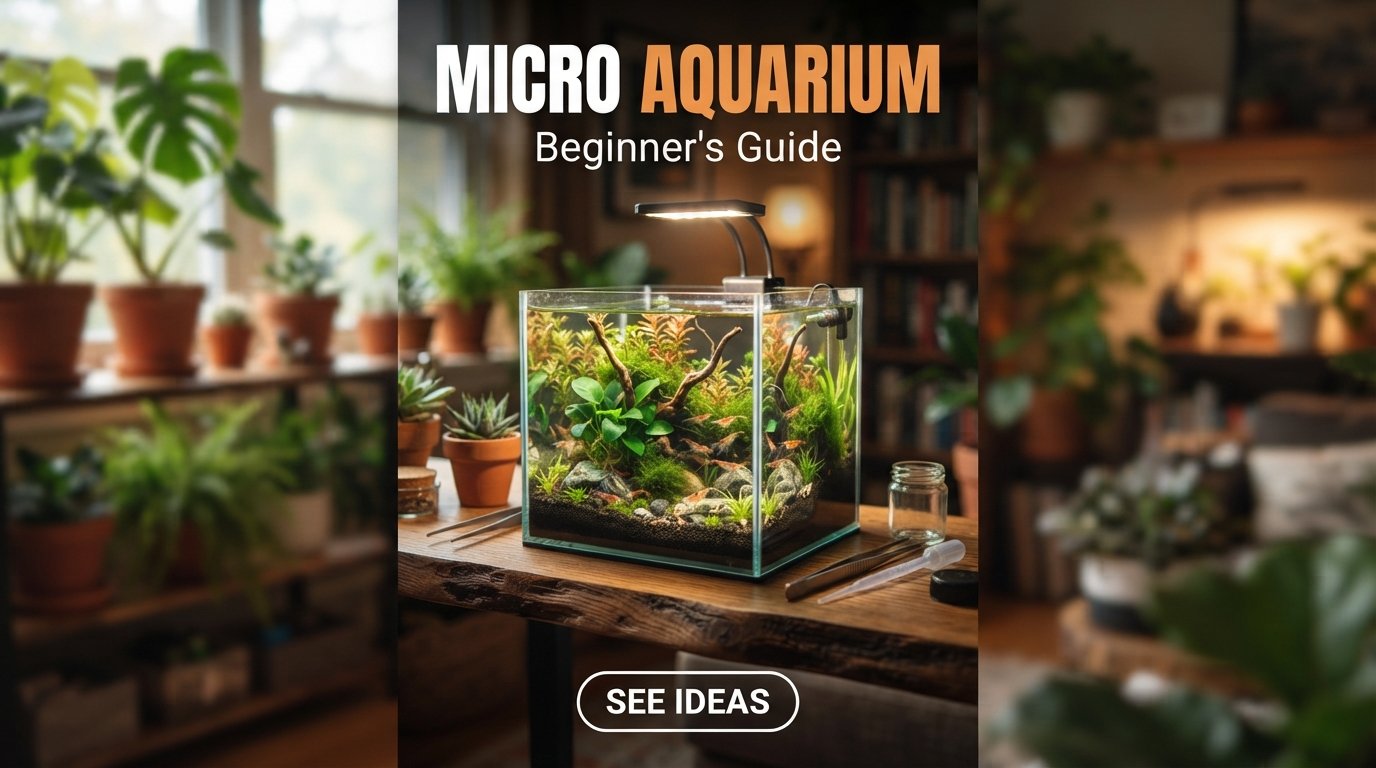
A micro aquarium is a very small aquarium designed to create a beautiful aquatic environment in a compact space. These tiny tanks are popular with beginners, aquascaping enthusiasts, shrimp keepers, and people who want an attractive natural display without dedicating a large area to a traditional aquarium.
Despite their small size, micro aquariums require careful planning. Because the water volume is limited, temperature, water quality, and chemical changes can happen quickly. Choosing the right livestock, plants, substrate, lighting, and filtration is therefore especially important.
What Is a Micro Aquarium?
A micro aquarium is generally a small aquarium designed around a compact footprint and low water volume. There is no universal size that defines a micro aquarium, but many setups fall somewhere around 1 to 10 gallons.
Some micro aquariums are designed primarily as planted displays, while others house small freshwater animals such as shrimp or a carefully selected single fish.
The main attraction is the ability to create a miniature underwater ecosystem in a very small space.
A well-designed micro aquarium can include:
- Aquatic plants
- Rocks and driftwood
- Sand or planted substrate
- Small freshwater shrimp
- Snails
- Small fish in appropriately sized setups
- LED lighting
- Compact filtration
- Decorative hardscape
Why Choose a Micro Aquarium?
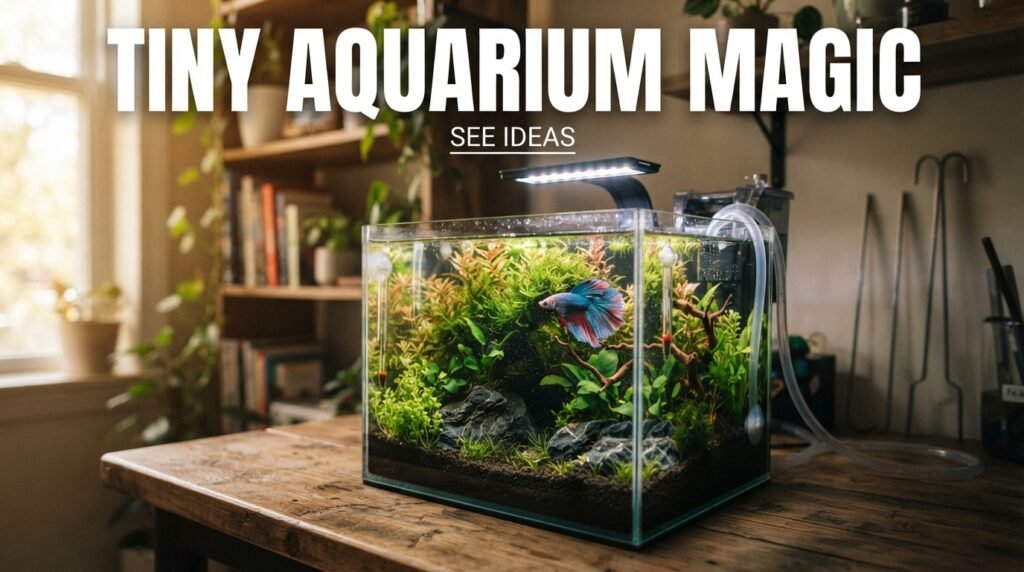
Micro aquariums are appealing because they combine aquarium keeping with interior decoration.
Great for Small Spaces
A micro aquarium can fit on:
- Desks
- Shelves
- Bedside tables
- Kitchen counters
- Office furniture
- Small cabinets
- Apartment interiors
You don’t need a large room or dedicated aquarium stand.
Lower Initial Cost
A small aquarium generally requires less substrate, fewer plants, and smaller equipment than a large aquarium. This can make it an affordable way to start learning about aquascaping.
However, smaller does not always mean easier. Tiny aquariums can actually require more attention to water stability.
Beautiful Aquascaping Opportunities
Because the viewing area is compact, even a few carefully selected plants and rocks can create a dramatic composition.
A small piece of driftwood covered with moss, for example, can become the main focal point of an entire micro aquascape.
Micro Aquarium Size Guide
| Aquarium Size | Best Use | Livestock Potential | Difficulty |
|---|---|---|---|
| 1–2 gallons | Plant display | Plants, possibly snails | High |
| 2–3 gallons | Nano planted display | Shrimp/snails depending on conditions | Moderate–High |
| 3–5 gallons | Shrimp aquarium | Shrimp and snails | Moderate |
| 5–10 gallons | Small planted aquarium | Shrimp and carefully selected livestock | Moderate |
| 10 gallons | Larger nano setup | More livestock options | Easier to stabilize |
The smaller the aquarium, the less room there is for mistakes.
Best Micro Aquarium Ideas
There are many ways to design a micro aquarium. The best style depends on the available space and whether you want a natural, minimalist, colorful, or decorative appearance.
1. Minimalist Micro Aquarium
A minimalist aquarium uses only a few elements.
Try:
- Fine sand
- One attractive rock
- A small piece of wood
- One or two plant species
- Simple lighting
Leave plenty of open space around the focal point.
This creates a clean and modern appearance.
2. Micro Shrimp Aquarium
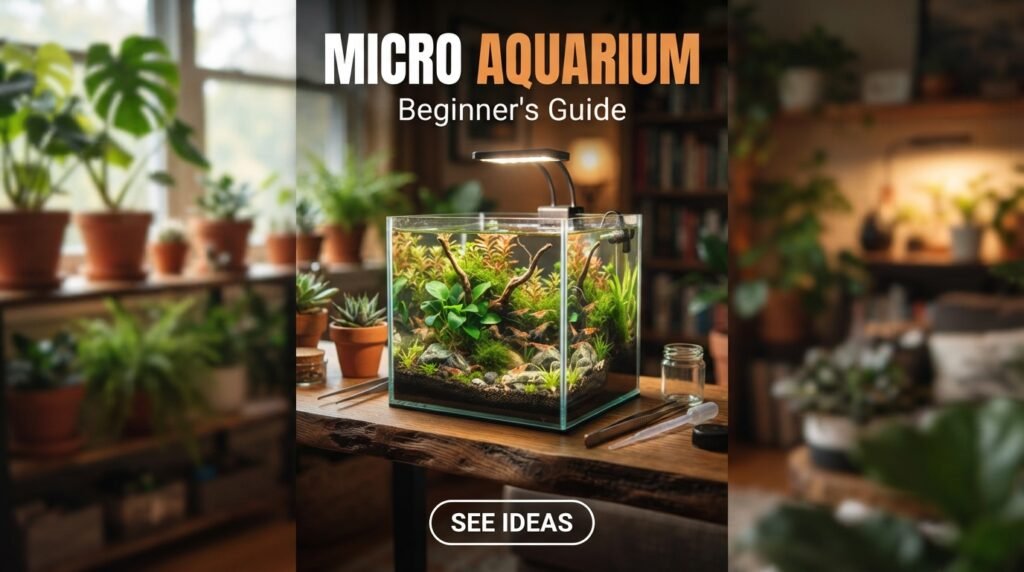
Shrimp are particularly popular for small planted aquariums because they are fascinating to watch and work beautifully with natural aquascapes.
A shrimp-focused setup can contain:
- Moss
- Anubias
- Java fern
- Small carpeting plants
- Driftwood
- Smooth stones
- Biofilm-producing surfaces
Shrimp also spend considerable time grazing on surfaces, making plants and hardscape important parts of the environment.
3. Moss Micro Aquarium
A moss aquarium is one of the simplest ways to create a miniature underwater forest.
Attach aquarium-safe moss to:
- Driftwood
- Rocks
- Small branches
- Decorative structures
As the moss grows, it creates a soft green appearance that can make a tiny aquarium look much more established.
4. Micro Jungle Aquarium
For a more natural appearance, use several different plant heights.
Place:
- Short plants in the foreground
- Medium plants in the middle
- Taller plants toward the back
This creates depth even though the aquarium itself is extremely small.
5. Zen Micro Aquarium
A Zen-inspired aquarium can use:
- Light-colored sand
- Dark stones
- Minimal vegetation
- A single piece of driftwood
The goal is simplicity rather than filling every available space.
6. Desktop Micro Aquarium
A small aquarium can become an attractive desk feature.
Keep the design visually simple so it doesn’t become distracting. A small planted tank with moss and a few rocks can provide a natural focal point without taking up much workspace.
7. Micro Aquarium With Driftwood
A small piece of twisted driftwood can make a tiny tank look much larger.
Choose a piece that has interesting branches but doesn’t dominate the entire aquarium.
You can attach moss to the branches to create the appearance of a miniature underwater tree.
8. Rock-Focused Micro Aquascape
Rocks can be the main feature of a tiny aquarium.
Use different sizes to create a natural composition, with one dominant stone and several smaller supporting rocks.
Avoid using too many different rock types because this can make a small aquascape look cluttered.
Best Plants for a Micro Aquarium
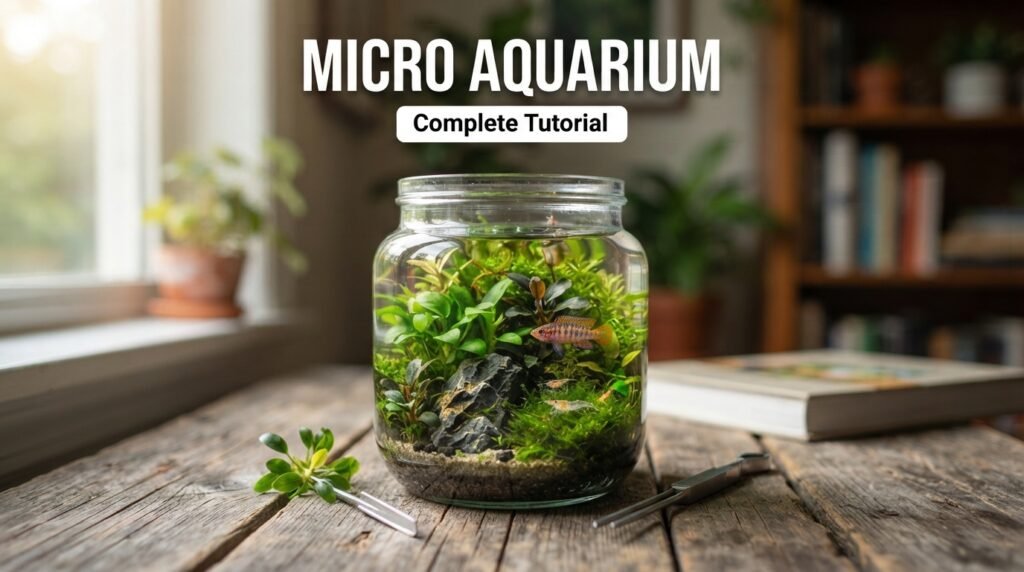
Choosing plants that remain relatively compact is important.
Some popular options include:
Java Moss
Java moss is useful for tiny aquariums because it can attach to hardscape and create a natural green texture.
Anubias Nana Petite
This compact Anubias variety works particularly well in small aquascapes.
It grows slowly and can be attached to rocks or wood.
Java Fern
Small Java fern varieties can provide larger leaves without requiring complicated planting techniques.
Bucephalandra
Bucephalandra varieties are excellent for miniature aquascapes because many remain small and have attractive leaves.
Cryptocoryne
Small Cryptocoryne varieties can add midground structure and natural color.
Dwarf Hairgrass
When conditions are suitable, dwarf hairgrass can create a grassy foreground.
Monte Carlo
Monte Carlo can be used for carpeting in planted micro aquariums, although successful growth depends on lighting, nutrients, CO₂ availability, and overall tank conditions.
How to Set Up a Micro Aquarium
Creating a micro aquarium is easier when you build it in stages.
Step 1: Choose the Aquarium
Select a tank with enough space for the type of setup you want.
A slightly larger tank is generally easier for beginners because additional water volume provides greater stability.
Step 2: Add the Substrate
Choose substrate according to your plants.
Possible options include:
- Aquarium soil
- Fine gravel
- Sand
- Nutrient-rich planted substrate
If using sand, avoid excessively deep layers in a tiny aquarium because compacted areas can become difficult to maintain.
Step 3: Create the Hardscape
Add rocks and driftwood before planting.
Think about the composition from the front viewing angle.
Instead of placing everything directly in the center, consider an off-center focal point for a more natural appearance.
Step 4: Add Plants
Plant according to height.
Keep taller plants toward the rear and shorter plants toward the front.
Epiphytic plants such as Anubias and Bucephalandra can be attached to rocks or wood rather than buried.
Step 5: Fill the Aquarium Slowly
Pour water gently to avoid disturbing the substrate.
A small container, plastic bag, or similar method can help reduce substrate disturbance while filling.
Step 6: Install Equipment
Depending on the setup, you may need:
- Small filter
- Aquarium light
- Heater
- Thermometer
- Water conditioner
- Timer
Not every micro aquarium needs every piece of equipment. The requirements depend on its size, livestock, plants, and room conditions.
Do Micro Aquariums Need a Filter?
A filter can be extremely useful because it provides mechanical and biological filtration and helps maintain water movement.
For very small aquariums, a small sponge filter is often a practical option, particularly for shrimp.
The filter should not create excessive water movement that stresses small livestock.
If you’re considering a no-filter setup, understand that it is not maintenance-free. A planted aquarium still requires careful management of stocking, feeding, water quality, and plant growth.
Can You Keep Fish in a Micro Aquarium?
This is one of the most important considerations.
Not every fish is suitable for a tiny aquarium.
Fish need enough swimming space and stable water conditions. A tank that looks large in a store may feel extremely restrictive once decorated and filled with equipment.
For very small aquariums, a planted display with shrimp and snails is often more appropriate than keeping fish.
Always choose livestock based on its adult size, behavior, swimming requirements, and water-quality needs rather than simply choosing an animal because it is small.
Micro Aquarium for Shrimp
A shrimp aquarium can be an excellent choice for a compact setup.
Shrimp benefit from:
- Stable water parameters
- Mature biological filtration
- Plenty of surfaces for grazing
- Plants and moss
- Hiding places
- Gentle water movement
A mature planted aquarium can develop biofilm and microorganisms that shrimp naturally graze on.
Avoid overfeeding. Excess food can rapidly degrade water quality in a tiny aquarium.
Micro Aquarium With Snails
Small freshwater snails can also work well in appropriate setups.
They can help consume algae and leftover food, although they should not be considered a replacement for regular aquarium maintenance.
A snail population can increase rapidly if there is abundant food, so feeding should remain controlled.
Lighting for a Micro Aquarium
Lighting is especially important for planted micro aquariums.
A small LED aquarium light can provide the illumination needed for aquatic plants while also making the aquascape visually attractive.
Using a timer can help maintain a consistent lighting schedule.
Too much light can encourage algae growth, particularly when nutrient and carbon dioxide conditions are unbalanced.
Instead of simply increasing lighting duration, focus on creating a balanced system involving:
- Light
- Nutrients
- Carbon availability
- Plant growth
- Water quality
Micro Aquarium Maintenance
The small size of a micro aquarium means maintenance should be performed carefully.
Regular Tasks
Depending on the aquarium, maintenance may include:
- Removing algae
- Trimming plants
- Cleaning the glass
- Checking equipment
- Testing water parameters
- Removing dead leaves
- Performing partial water changes
- Cleaning filter media when necessary
Avoid completely replacing all the water or aggressively cleaning every surface unless there is a specific reason.
Beneficial microorganisms are important to the aquarium ecosystem.
Why Micro Aquariums Can Be Difficult
A small aquarium has very little water to dilute waste and chemical changes.
For example, adding too much food can have a much greater impact in a 2-gallon aquarium than in a 50-gallon aquarium.
Temperature can also change quickly.
This is why a micro aquarium should not be treated as a decorative bowl that can simply be filled and forgotten.
Common Micro Aquarium Mistakes
Overstocking
Adding too many animals is one of the biggest mistakes.
The aquarium’s biological capacity matters more than its physical appearance.
Overfeeding
Uneaten food decomposes and contributes to water-quality problems.
Feed conservatively and observe how quickly livestock consumes the food.
Too Much Decoration
A tiny aquarium can become visually crowded very quickly.
Use fewer, better-selected elements.
Ignoring the Nitrogen Cycle
A new aquarium needs biological filtration to establish before it can safely support livestock.
Cycling the aquarium before adding animals is an important part of responsible fishkeeping.
Using Unsafe Decorations
Avoid objects that can release harmful chemicals, sharp edges, paint, or unknown materials into aquarium water.
Only use aquarium-safe decorations.
How to Make a Micro Aquarium Look Bigger
You can make a small aquarium appear surprisingly spacious with a few design techniques.
Use Perspective
Place larger elements closer to the foreground and smaller elements farther back.
Leave Open Areas
Open sand or substrate can create the illusion of additional space.
Use a Focal Point
One dominant rock or piece of driftwood is often more effective than many small decorations.
Create Plant Layers
Use different plant heights to create visual depth.
Keep the Glass Clean
Clean glass makes a surprisingly large difference in the appearance of a tiny aquarium.
Micro Aquarium Color Ideas
You can create different moods through livestock, plants, substrate, and lighting.
Natural Green
Use green plants, brown driftwood, and natural-colored rocks.
Black and Green
Black substrate combined with bright green plants creates a dramatic modern look.
White and Green
Light sand with green plants creates a bright minimalist appearance.
Red Plant Accent
A small amount of red vegetation can become an attractive focal point when used carefully.
Micro Aquarium vs Nano Aquarium
The terms micro aquarium and nano aquarium are often used interchangeably, although hobbyists sometimes use them to describe different size ranges.
The important consideration isn’t the label. What matters is the actual water volume and the needs of the livestock.
A smaller aquarium generally requires more careful management because changes happen faster.
Best Micro Aquarium Setup for Beginners
For a beginner, a simple planted shrimp aquarium can be a good starting point.
A basic concept could include:
- 3–5 gallon aquarium
- Sponge filter
- Appropriate aquarium light
- Aquatic moss
- Anubias or Bucephalandra
- Small amount of driftwood
- Natural rocks
- Suitable substrate
- Freshwater shrimp after the aquarium is properly cycled
This setup avoids the complexity of maintaining a large fish population while still allowing you to learn important aquarium skills.
Final Thoughts
A micro aquarium proves that you don’t need a huge tank to create a beautiful underwater world. With the right plants, hardscape, lighting, filtration, and livestock, even a small aquarium can become an impressive natural centerpiece.
The key is to resist the temptation to add too much. In a tiny aquarium, simplicity, stability, and careful maintenance are more important than decoration or stocking density.
For beginners, a planted shrimp-focused aquarium can be an especially attractive option. For aquascaping enthusiasts, a micro tank provides an opportunity to experiment with miniature landscapes and creative compositions in a very small footprint.
Frequently Asked Questions
What is the smallest size for a micro aquarium?
There is no universal minimum size. Very small tanks can be used for plants, but extremely small volumes are difficult to keep stable and are generally unsuitable for most fish.
Are micro aquariums good for beginners?
They can be, but very tiny aquariums are not necessarily easier. Beginners may find a slightly larger nano aquarium easier because the additional water volume provides more stability.
Can I keep shrimp in a micro aquarium?
Shrimp can be suitable for some small aquariums when the tank is properly established and water conditions remain stable. Tank size, shrimp species, filtration, temperature, and water chemistry all matter.
Can a micro aquarium have live plants?
Yes. Many aquatic plants are excellent choices for micro aquariums, including mosses, small Anubias, Bucephalandra, Java fern varieties, and suitable carpeting plants.
Does a micro aquarium need a filter?
A filter is often beneficial, especially when keeping livestock. A small sponge filter is a popular option because it provides biological filtration while producing relatively gentle water movement.
How often should I change water in a micro aquarium?
There isn’t one schedule that works for every aquarium. Water changes should be based on the tank’s livestock, feeding, plants, water parameters, and maintenance needs. Small, consistent changes are generally preferable to large, unnecessary disruptions.
Can I keep a betta in a micro aquarium?
A very small aquarium is generally not an appropriate choice for a betta. Bettas need adequate swimming space, stable water conditions, filtration, and appropriate temperature. A larger properly equipped aquarium is a better option.
How do I prevent algae in a micro aquarium?
Keep lighting, nutrients, and plant growth balanced. Avoid excessive feeding and excessively long lighting periods, and remove algae manually when necessary.
Is a micro aquarium expensive?
A small aquarium can cost less than a large setup, but quality equipment and livestock still require an investment. Cutting costs by using unsafe materials or unsuitable equipment can create problems later.
What is the best micro aquarium for aquascaping?
A small planted aquarium with a simple hardscape is an excellent choice. A single piece of driftwood, a few carefully positioned rocks, moss, and compact plants can create a convincing miniature landscape.