
 By admin
A nano aquarium is a small aquarium that brings the beauty of an underwater world into a compact space. These tanks are especially popular with aquascaping enthusiasts because even a small aquarium can become a detailed miniature landscape.
Nano aquariums can be designed for shrimp, snails, small aquatic plants, or carefully selected fish depending on the tank’s actual size and dimensions. They are also excellent for desks, bedrooms, offices, apartments, shelves, and other places where a large aquarium isn’t practical.
However, a smaller aquarium isn’t automatically easier to maintain. Because nano tanks contain less water, changes in temperature and water chemistry can happen more quickly. Good planning and regular maintenance are therefore essential.
What Is a Nano Aquarium?
The term nano aquarium generally refers to a small aquarium, although there is no single universally accepted size.
Many hobbyists use the term for aquariums under approximately 10 gallons, while others include somewhat larger compact aquariums.
Nano aquariums can include:
- Planted aquariums
- Shrimp tanks
- Betta setups
- Small community aquariums
- Aquascaping displays
- Snail aquariums
- Low-tech planted tanks
- Desktop aquariums
The most important thing is not the label “nano.” What matters is the aquarium’s actual water volume and dimensions.
1. Minimalist Nano Aquarium
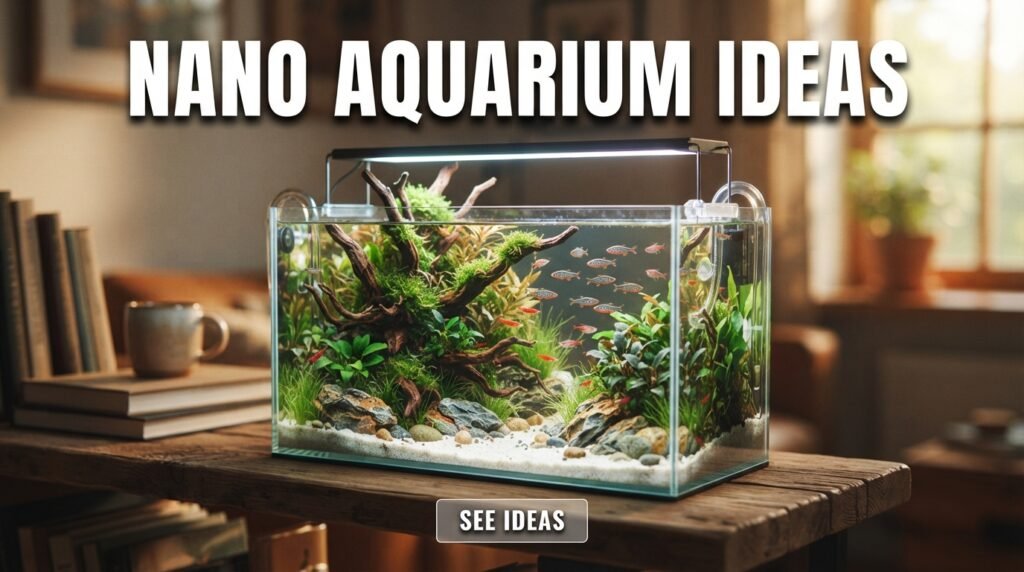
A minimalist nano aquarium is one of the easiest designs to make look professional.
Instead of filling the aquarium with decorations, use just a few carefully selected elements.
A simple layout can include:
- Fine natural substrate
- One main rock
- A small piece of driftwood
- Moss
- One or two compact plants
Leave plenty of open space around the focal point.
This makes the aquarium look larger and cleaner.
2. Nano Shrimp Aquarium
Shrimp are among the most popular inhabitants for nano aquariums.
A shrimp-focused aquascape can include:
- Moss
- Small Anubias
- Bucephalandra
- Driftwood
- Smooth rocks
- Small caves
- Live plants
Plants and hardscape also provide surfaces where biofilm can develop, which shrimp naturally graze on.
The aquarium should be properly established before introducing livestock.
3. Nano Planted Aquarium
A planted nano aquarium can look like a miniature underwater garden.
Use plants with different heights to create depth.
Place:
Foreground: carpeting or low-growing plants
Middle: compact plants
Background: taller plants
Avoid selecting plants only because they look small when purchased. Always consider their mature size.
4. Nano Aquascape With Driftwood
A small piece of driftwood can completely transform a nano aquarium.
Choose wood with an interesting shape rather than simply using the largest piece you can find.
Branching driftwood can resemble a miniature underwater tree.
Attach suitable moss to the branches to create a natural appearance.
5. Nano Forest Aquarium
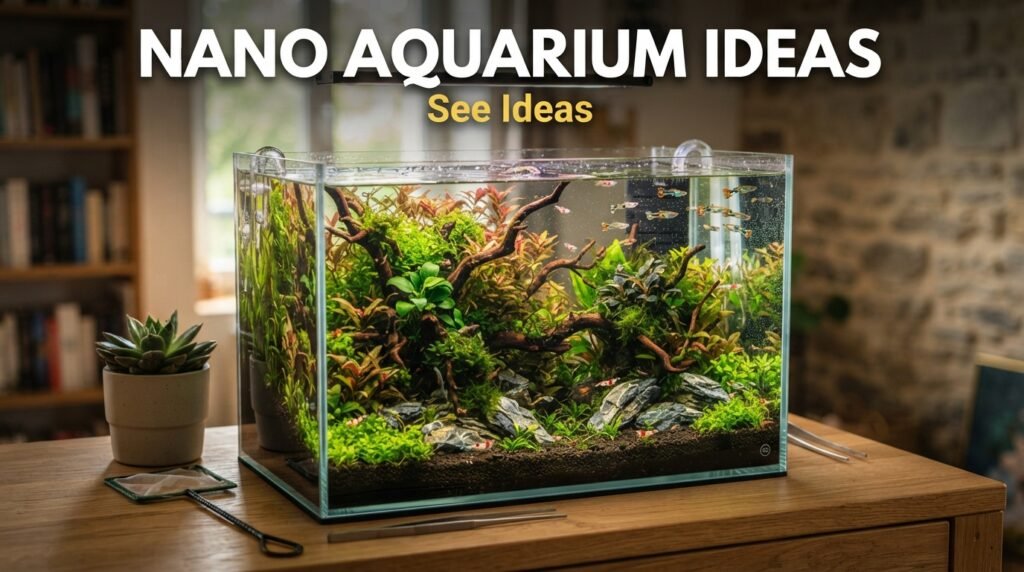
Create a miniature underwater forest using several pieces of branching wood.
Arrange the wood so that it rises upward from the substrate.
Add moss and small plants around the base.
Leave open space between the branches so the aquarium doesn’t look overcrowded.
This design works particularly well in rectangular nano tanks.
6. Nano Rock Aquascape
A rock-focused aquascape can create a dramatic landscape even in a very small aquarium.
Choose one dominant rock and several smaller supporting rocks.
Arrange them so that they appear naturally connected.
Avoid using too many different rock colors or textures because this can make a small aquarium look chaotic.
7. Nano Iwagumi Aquarium
Iwagumi-inspired layouts use rocks as the main feature.
A typical design has:
- One dominant stone
- Several supporting stones
- Simple foreground plants
- Open substrate
The simplicity of the design makes it particularly effective in a small aquarium.
8. Nano Jungle Aquarium
If you prefer a dense natural appearance, create a miniature jungle.
Use several plant species with different leaf shapes and heights.
Allow some plants to grow naturally rather than trimming everything into perfect shapes.
A dense nano jungle can create a vibrant environment for suitable shrimp and snails.
9. Nano Aquarium With Moss
Moss is one of the most useful plants for nano aquariums.
You can attach moss to:
- Rocks
- Driftwood
- Small branches
- Aquarium decorations
As it grows, it creates a soft green texture that makes the hardscape look mature.
10. Nano Betta Aquarium
A suitably sized nano aquarium can be designed around a betta, but the aquarium must meet the fish’s actual care requirements.
Use:
- Live plants
- Smooth hardscape
- Gentle filtration
- Appropriate heating
- A secure lid where appropriate
- Open swimming areas
Avoid sharp rocks, rough decorations, and narrow gaps that could damage the betta’s fins.
A larger aquarium is generally easier to keep stable than an extremely small tank.
11. Nano Aquarium With Snails
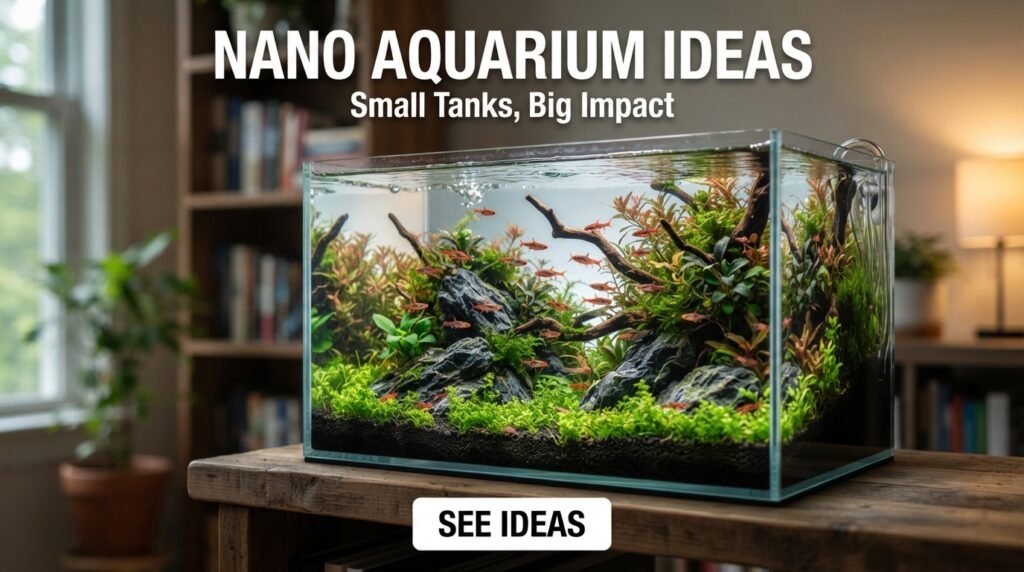
Snails can make interesting inhabitants for suitable nano aquariums.
They move slowly around the glass, plants, rocks, and substrate while feeding on algae and available food.
Don’t rely on snails as a substitute for maintenance, and avoid excessive feeding because abundant food can encourage unwanted population growth.
12. Nano Aquarium for a Desk
A small aquarium can make an attractive desktop feature.
For a professional office environment, consider a simple planted design with:
- Green plants
- Small stones
- Driftwood
- Clean glass
- Compact filtration
- Subtle lighting
Keep the design relatively simple so the aquarium doesn’t become distracting.
13. Nano Aquarium for a Bedroom
A small planted aquarium can work beautifully in a bedroom.
Choose quiet equipment and avoid excessively bright lighting at night.
A simple aquascape with dark substrate, green plants, and natural wood can create a peaceful appearance.
14. Nano Aquarium for an Apartment
Nano aquariums are ideal when floor space is limited.
They can fit on:
- Shelves
- Small cabinets
- Desks
- Side tables
- Kitchen counters
- Dedicated aquarium stands
Always ensure that the furniture can safely support the complete weight of the aquarium.
15. Nano Aquarium With Black Substrate
Black substrate creates strong contrast with bright green plants.
It can also make colorful shrimp and fish stand out.
Combine it with:
- Green moss
- Pale rocks
- Natural driftwood
- Dark background
for a modern aquascape.
16. Nano Aquarium With White Sand
White or light-colored aquarium sand creates a completely different appearance.
It gives the tank a brighter and more open feeling.
Pair it with:
- Green plants
- Dark rocks
- Brown driftwood
- Minimal decorations
for a natural beach or tropical-inspired appearance.
17. Nano Aquarium With Red Plants
Red plants can become a beautiful focal point in a nano aquarium.
Because the tank is small, you don’t need many red plants.
One small area of red foliage surrounded by green plants can provide enough contrast.
Remember that different red plants have different lighting and nutrient requirements.
18. Nano Blackwater Aquarium
A blackwater-inspired nano aquarium can use natural-looking materials such as:
- Driftwood
- Leaf litter appropriate for aquarium use
- Dark substrate
- Tannins
- Low-light plants
The water may develop a tea-colored appearance from tannins released by natural materials.
Before creating a blackwater setup, research the water requirements of the livestock you plan to keep.
19. Nano Aquarium With Cave
A small cave can provide visual interest and hiding space.
Create the cave with aquarium-safe rocks or a purpose-made aquarium decoration.
Place plants around the entrance to make it blend into the aquascape.
Never build unstable rock structures.
20. Nano Aquarium With Bonsai-Style Tree
A miniature tree aquascape is a popular concept for small planted tanks.
Use branching driftwood to create a tree-like shape and attach moss to the branches.
Place smaller plants around the base.
The result resembles a miniature underwater landscape.
21. Nano Aquarium With Floating Plants
Floating plants can add another visual layer.
They occupy the surface while rooted plants fill the lower portions of the aquarium.
However, floating plants shouldn’t completely cover the surface because they can block light and interfere with gas exchange.
22. Nano Aquarium With Blue Lighting
Blue-toned lighting can create a dramatic appearance, but it should be used carefully.
For planted aquariums, the lighting needs to support plant growth rather than simply creating a particular color effect.
A subtle blue appearance during appropriate viewing periods can work as an accent, while the primary lighting should remain suitable for the aquarium’s plants and livestock.
23. Nano Aquarium With Natural Stone
Natural-looking stone is an excellent choice for a minimalist nano aquascape.
Use stones with similar textures and colors.
One larger stone can act as the focal point, with smaller stones creating a natural transition around it.
24. Nano Aquarium With Ancient Ruins
A small aquarium-safe ruin can turn a simple nano tank into a fantasy landscape.
Try creating an abandoned underwater structure surrounded by moss and plants.
Keep the decoration proportionate to the tank.
A giant castle in a tiny aquarium can make the layout look unrealistic.
25. Nano Aquarium With Gothic Design
A gothic nano aquarium can use:
- Black substrate
- Dark rocks
- Twisted driftwood
- Moss
- Ancient ruins
- Dark green plants
- Subtle lighting
Keep the design relatively simple because small tanks become cluttered very quickly.
Nano Aquarium Size Guide
| Size | Good Use | General Difficulty |
|---|---|---|
| 1–2 gallons | Plant display | High |
| 2–3 gallons | Small planted display | High |
| 3–5 gallons | Shrimp/snail-focused setup | Moderate |
| 5–10 gallons | Nano planted aquarium | Moderate |
| 10 gallons | More flexible nano setup | Easier |
These categories are only general guidelines. Livestock suitability depends on the species and the aquarium’s complete dimensions.
Best Plants for Nano Aquariums
Compact plants are usually the easiest to incorporate into a small aquascape.
Anubias Nana Petite
This compact plant can work very well in small aquariums and can be attached to rocks or driftwood.
Java Moss
Java moss is excellent for covering hardscape and creating a natural appearance.
Java Fern
Smaller Java fern varieties can add height without requiring complicated planting.
Bucephalandra
Bucephalandra is popular among aquascapers because many varieties remain relatively compact.
Cryptocoryne
Small Cryptocoryne varieties can provide attractive midground growth.
Monte Carlo
Monte Carlo can create a carpet when conditions are appropriate, although successful growth depends on lighting, nutrients, substrate, and carbon availability.
Dwarf Hairgrass
Dwarf hairgrass can create a grass-like foreground in suitable planted nano aquariums.
Nano Aquarium Equipment
A basic nano aquarium may require:
- Aquarium light
- Small filter
- Heater when needed
- Thermometer
- Water conditioner
- Substrate
- Aquarium-safe hardscape
- Water-testing equipment
The exact equipment depends on the aquarium and its livestock.
Does a Nano Aquarium Need a Filter?
For livestock-based setups, filtration is generally very useful.
A small sponge filter is particularly popular for shrimp because it provides biological filtration and usually produces gentle water movement.
Some planted displays can be operated with specialized low-tech approaches, but this doesn’t mean they are maintenance-free.
Can You Keep Fish in a Nano Aquarium?
This depends entirely on the aquarium’s size and dimensions and the species involved.
The phrase “nano fish” doesn’t mean a fish can live comfortably in any tiny tank.
Consider:
- Adult size
- Swimming behavior
- Social requirements
- Bioload
- Temperature
- Water chemistry
- Filtration
- Swimming length
Many fish need more horizontal swimming space than a very small aquarium can provide.
For very small tanks, planted displays with appropriate invertebrates may be a better choice.
Nano Aquarium Cycling
Before adding livestock, establish the aquarium’s biological filtration.
The nitrogen cycle allows beneficial microorganisms to process toxic ammonia and nitrite.
A new aquarium should not be stocked simply because the water looks clear.
Testing water parameters is an important part of determining whether an aquarium is ready for livestock.
Nano Aquarium Maintenance
Small tanks require consistent maintenance because their limited water volume can change rapidly.
Regular tasks include:
- Checking water parameters
- Removing algae
- Cleaning the glass
- Trimming plants
- Removing dead leaves
- Performing appropriate water changes
- Checking filtration
- Monitoring temperature
- Observing livestock
Avoid making large changes unnecessarily.
Stability is especially valuable in small aquariums.
How to Make a Nano Aquarium Look Bigger
You can make a tiny aquarium appear significantly larger with aquascaping techniques.
Leave Negative Space
Don’t cover the entire substrate with plants and decorations.
Create a Focal Point
One dominant rock or piece of wood is often more effective than many small decorations.
Use Perspective
Place larger elements toward the front and smaller elements toward the back.
Create Plant Layers
Different plant heights create the illusion of depth.
Keep the Glass Clean
Clean glass makes a small aquarium look brighter and more spacious.
Common Nano Aquarium Mistakes
Overstocking
Adding too many animals is one of the biggest problems in small aquariums.
Overfeeding
Excess food decomposes quickly and can damage water quality.
Too Much Decoration
Small tanks become cluttered very easily.
Ignoring the Nitrogen Cycle
Clear water does not necessarily mean the aquarium is biologically ready.
Using Inappropriate Fish
A fish being small doesn’t automatically make it suitable for a nano aquarium.
Excessive Lighting
Too much light can encourage algae, particularly when the aquarium isn’t properly balanced.
Poor Temperature Control
Small aquariums can experience rapid temperature changes.
Best Nano Aquarium Setup for Beginners
A simple 5-gallon planted shrimp aquarium can be an excellent starting point for someone interested in nano aquascaping.
A basic concept could include:
- 5-gallon aquarium
- Sponge filter
- Suitable LED light
- Aquarium substrate
- Small driftwood
- A few natural rocks
- Java moss
- Anubias or Bucephalandra
- Appropriate freshwater shrimp after cycling
This gives you an opportunity to learn about plants, filtration, water chemistry, feeding, and maintenance without managing a large fish community.
Final Thoughts
Nano aquarium ideas prove that you don’t need a large tank to create an impressive underwater world. A carefully designed small aquarium can become a beautiful miniature landscape for your home, office, bedroom, or apartment.
The most important principle is to keep the aquarium balanced. Choose livestock carefully, use appropriately sized plants and decorations, establish biological filtration before stocking, and maintain stable water conditions.
Whether you prefer a minimalist rockscape, lush jungle, shrimp tank, bonsai-style aquascape, blackwater setup, gothic design, or simple planted aquarium, a nano tank gives you plenty of opportunities to be creative.
Frequently Asked Questions
What is a nano aquarium?
A nano aquarium is a small aquarium designed for compact spaces and small-scale aquatic displays. There is no universal size definition, but the term is commonly used for small tanks under roughly 10 gallons.
Are nano aquariums easy to maintain?
They can be attractive and manageable, but very small aquariums can actually be less forgiving than larger tanks. Water temperature and chemistry can change quickly because there is less water volume.
What is the best size for a beginner nano aquarium?
A tank around 5–10 gallons can be easier for beginners than an extremely small aquarium because it provides greater water stability and more room for equipment and aquascaping.
Are shrimp good for nano aquariums?
Shrimp can be excellent inhabitants for appropriately sized and properly established nano aquariums. They benefit from plants, moss, hardscape, stable water conditions, and mature biological filtration.
Can I keep fish in a nano aquarium?
Some fish may be suitable for appropriately sized nano aquariums, but many require more swimming space than very small tanks provide. Always consider the adult requirements of the species.
What plants are best for nano aquariums?
Java moss, Anubias Nana Petite, Bucephalandra, small Java fern varieties, Cryptocoryne, Monte Carlo, and dwarf hairgrass can all be useful depending on the aquarium’s conditions.
Does a nano aquarium need a heater?
If you keep tropical livestock that requires warm, stable water, a suitable heater may be necessary. The need depends on the species and the temperature of the room.
How often should I clean a nano aquarium?
Maintenance frequency depends on livestock, feeding, plants, filtration, and water parameters. Regular observation and testing are more useful than following one fixed schedule for every tank.
Can I make a nano aquarium without a filter?
Some specialized planted displays can operate with alternative approaches, but livestock-based nano aquariums generally benefit from reliable biological filtration.
How can I make my nano aquarium look bigger?
Use negative space, a strong focal point, layered plants, carefully positioned hardscape, and perspective. Avoid filling every part of the aquarium with decorations.
What is the best nano aquarium idea?
For beginners, a simple planted shrimp aquarium is one of the most practical choices. For aquascaping enthusiasts, minimalist rockscapes, moss forests, bonsai-style layouts, and small jungle aquariums offer excellent creative possibilities.