
 By admin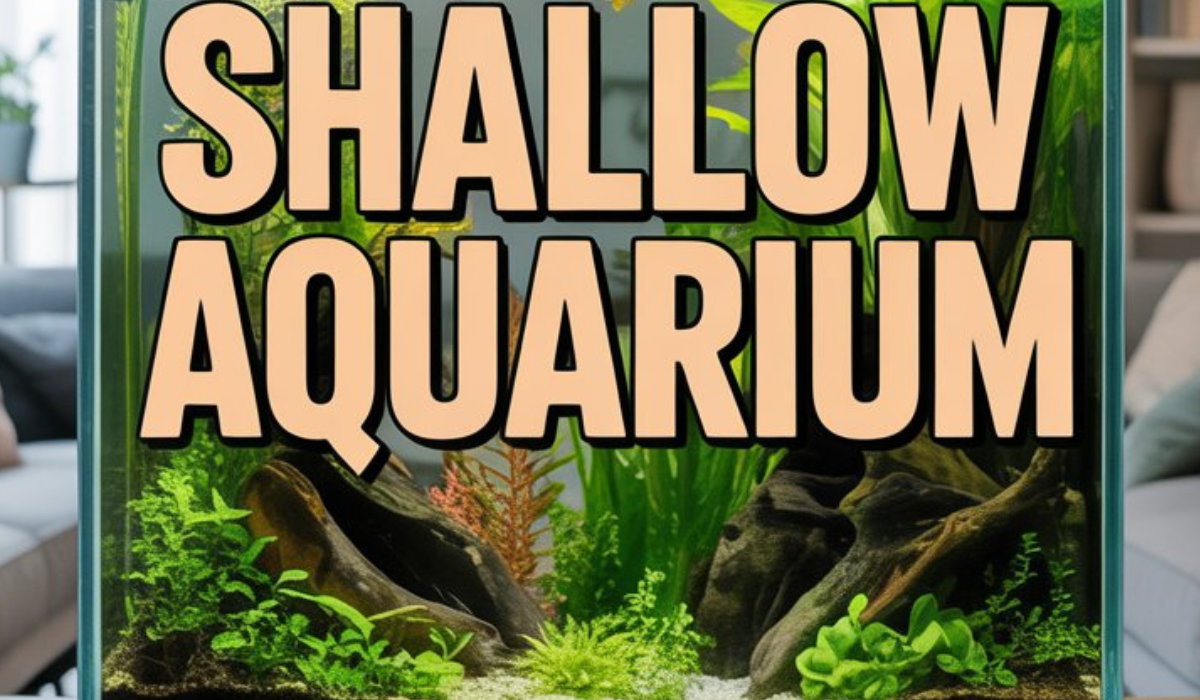
In a hobby where standard tanks are usually tall and boxy, shallow aquariums are a breath of fresh air. Defined by their unique, wide proportions—where the tank is significantly wider and longer than it is tall—shallow tanks are taking the aquascaping world by storm.
Whether you call them “shallow rims,” “bookshelf tanks,” or “lagoon style” aquariums, these low-profile setups offer a unique panoramic view and open up design possibilities that traditional tanks simply cannot match.
Here is everything you need to know about setting up, designing, and maintaining a thriving shallow aquarium.
Why Choose a Shallow Aquarium?
Shallow aquariums aren’t just a stylistic trend; they offer several distinct biological and functional advantages over standard tanks.
- Breathtaking Top-Down Viewing: Standard tanks force you to look only through the front glass. Shallow tanks invite you to look down from above. Without a lid, the water’s surface becomes a beautiful, reflecting canvas of ripples, floating plants, and fish behavior.
- Massive Gas Exchange: Because a shallow tank has a massive surface-area-to-volume ratio, it naturally absorbs oxygen and releases carbon dioxide far more efficiently than a tall tank. This creates a highly oxygenated environment that fish and beneficial bacteria love.
- Unrivaled Lighting Efficiency: Water depth is the number one enemy of aquarium lighting. In a deep tank, light loses intensity before hitting the floor. In a shallow tank (usually only 7 to 12 inches deep), even a budget-friendly LED light can reach the substrate with full intensity, allowing you to easily grow demanding carpeting plants.
- Effortless Maintenance: Say goodbye to soaking your armpits just to trim a plant or reposition a rock. In a shallow tank, your hands can easily reach every square inch of the substrate without making a mess.
Creative Design Styles for Shallow Tanks
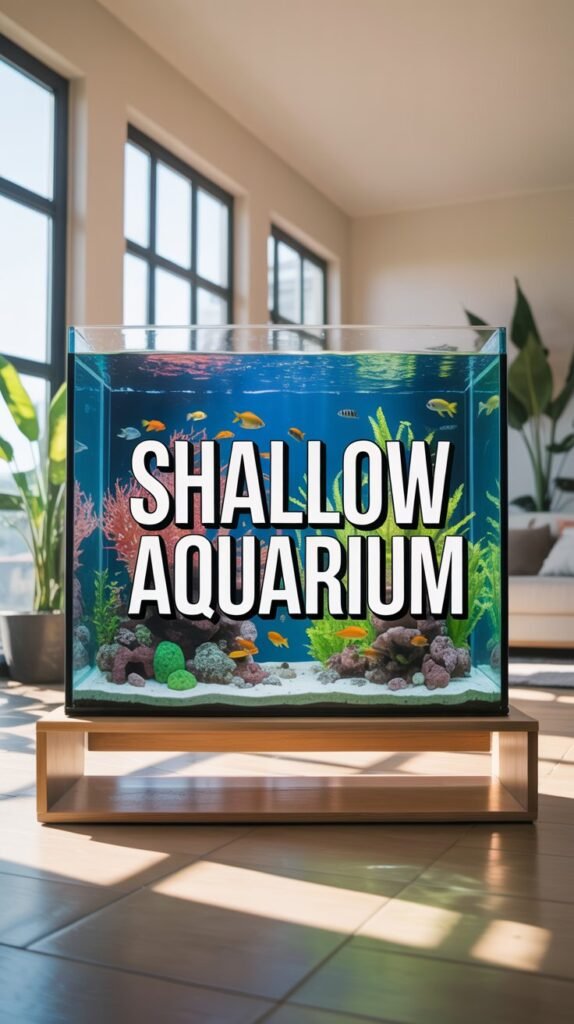
The unique footprint of a shallow tank allows for specific aquascaping styles that look awkward in standard aquariums.
1. The Pond/Riparium Style (The “Emersed” Look)
This is arguably the most popular way to style a shallow tank. Instead of keeping everything underwater, you allow your hardscape and plants to break through the surface and grow out into your room.
       \ | /  (Houseplants growing up into the room)
     -- POTHOS --
        / | \
~~~~~~~~~~~~~~~~~~~~~  <-- Water Line
     /  ROCK  \
    /__________\       <-- Substrate
- How it works: Use tall pieces of driftwood or large, volcanic rocks that protrude several inches out of the water.
- The Plants: Anchor semi-aquatic plants like Anubias, Java Fern, or even household plants like Pothos, Peace Lilies, and Mangrove shoots to the exposed wood. Their roots will stay submerged to clean the water, while their leaves grow lush and green in the open air.
2. The Panoramic Carpet (The High-Tech Iwagumi)
Because lighting penetrates shallow water so perfectly, these tanks are ideal for the classic Japanese Iwagumi style—which mimics a vast, minimalist mountain landscape using only stones and a low lawn of grass.
- How it works: Lay down a rich aquarium soil, place an odd number of beautiful stones (like Seiryu or Dragon stone) arranged dramatically, and plant a carpet of Dwarf Baby Tears, Monte Carlo, or Dwarf Hairgrass.
- The Visual Effect: It looks like a sweeping, vibrant green valley stretched across a wide-screen theater monitor.
3. The Shallow Creek / Riverbed Bed
You can replicate a slice of a natural stream or riverbed by taking advantage of the tank’s length.
- How it works: Pile smooth, rounded river pebbles and sand on one side of the tank, sloping it down toward the other side. Use a powerhead or filter outlet to create a strong, unidirectional current flowing down the length of the tank.
The Best Inhabitants for a Shallow Tank
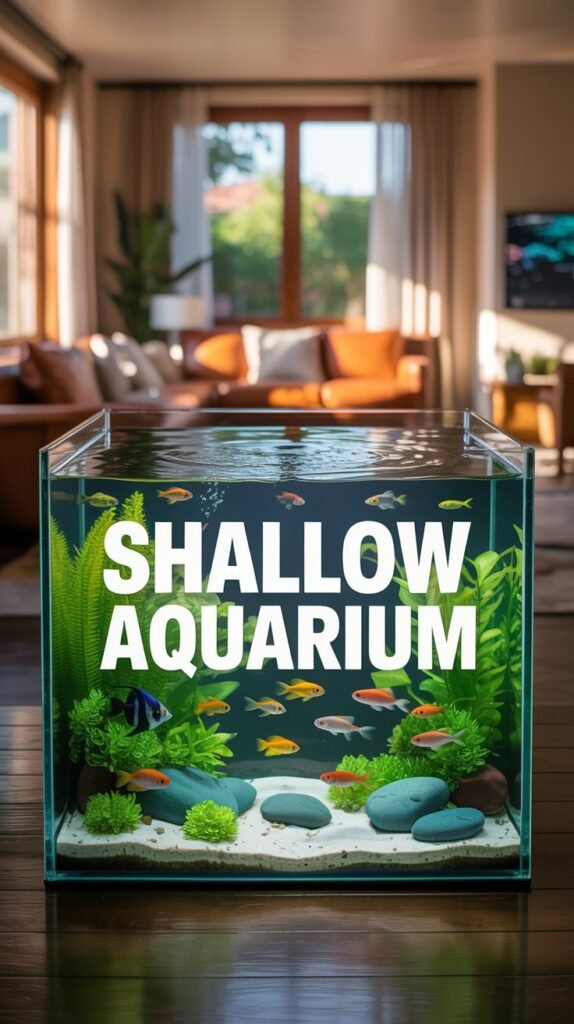
When stocking a shallow aquarium, you need to choose fish and invertebrates that appreciate horizontal swimming space and won’t immediately leap out of an open-top tank.
Schooling Nano Fish
Because shallow tanks offer a long, uninterrupted runway, small schooling fish look incredible as they zip back and forth in unison.
- Celestial Pearl Danios (CPDs)
- Neon or Cardinal Tetras
- Harlequin Rasboras
- Ember Tetras
Bottom Dwellers and Invertebrates
With so much floor space, bottom-dwelling creatures will be incredibly active and highly visible.
- Corydoras Catfish: (Specifically Pygmy or Panda Corys) They love to scurry across the wide substrate in groups.
- Kuhli Loaches: Their snake-like movements are highly entertaining to watch from a top-down view.
- Neocaridina Shrimp: (Cherry Shrimp, Blue Dreams) A shallow tank turns into a massive foraging playground for a thriving shrimp colony.
⚠️ The Golden Rule of Shallow Tank Stocking: Beware of jumpers! Because shallow tanks are almost always kept rimless and without a lid, you must avoid notorious jumping fish like Killifish, Hatchetfish, Betta fish, and certain rasboras. Even for safe fish, keep the water level about 1 to 1.5 inches below the rim to prevent accidental spills.
Equipment Considerations for Shallow Setups
Building a shallow tank requires a slightly different approach to hardware to keep the focus on your beautiful aquascape.
1. Filtration: Keep it Low Profile
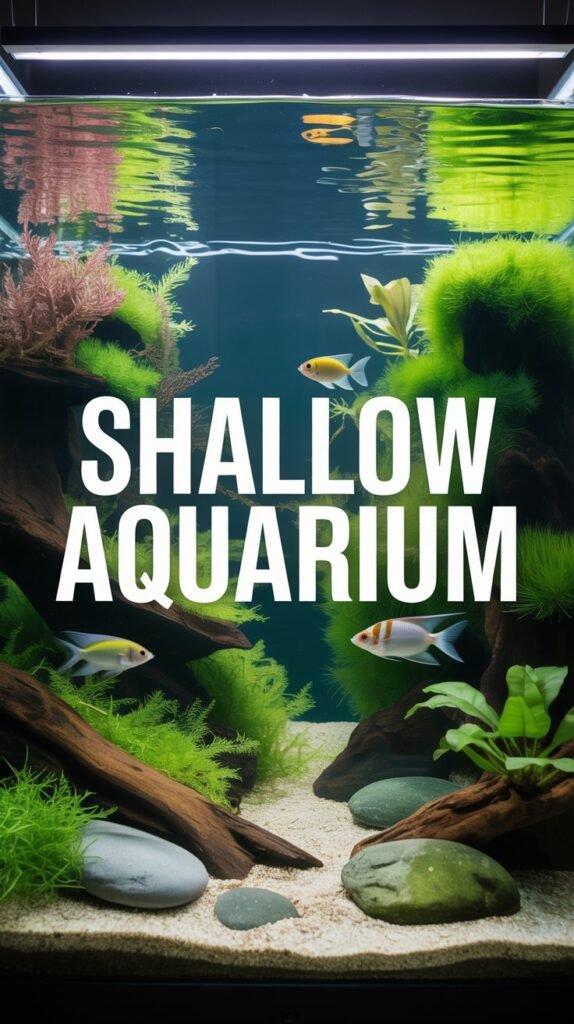
A giant, bulky intake tube or a massive internal filter will completely ruin the sleek lines of a shallow tank.
- Canister Filters with Lily Pipes: This is the gold standard. Use a canister filter hidden in the cabinet below, and run clear glass or acrylic “Lily Pipes” into the tank. They are virtually invisible in the water.
- Hang-on-Back (HOB) Filters: If you use a HOB filter, place it on one of the narrow side panes rather than the back pane. This pushes the water current down the long axis of the tank and keeps the back view clear.
2. Hanging or Clip-On Lights
Because plants and rocks often break out of the water surface, standard aquarium hoods or lights that sit flush on the glass rim won’t work.
- The Solution: Use an LED light fixture suspended from the ceiling by cables, or an adjustable light that clips securely onto the back glass and arches high over the tank. This gives your emersed plants plenty of room to grow upward.
Shallow Aquarium Pros and Cons at a Glance
| Pros | Cons |
| Spectacular 3D top-down and front viewing. | High rate of water evaporation (requires frequent top-offs). |
| Exceptional light penetration for carpeting plants. | Risk of fish jumping out if the tank is filled to the absolute brim. |
| Unbelievably easy to clean and prune plants. | Limited vertical space for tall background stem plants. |
| High oxygen levels due to massive surface area. | Finding properly scaled, low-profile equipment can be pricey. |
Conclusion
Shallow aquariums offer a completely fresh perspective on the fish-keeping hobby. They challenge you to think outside the glass box—quite literally—by blending the boundaries between your underwater aquascape and your indoor living space. If you love lush carpets, open-air setups, and highly interactive viewing, a shallow tank is the perfect canvas for your next aquatic masterpiece.
Are you planning to set this up as a high-tech planted tank with a vibrant green carpet, or are you leaning toward a low-maintenance riparium style with plants growing out of the top?