
 By admin
A paludarium aquarium is one of the most fascinating ways to bring a miniature natural ecosystem into your home. Unlike a traditional aquarium that focuses almost entirely on underwater life, a paludarium combines land and water in the same enclosure. This allows you to create a miniature rainforest, riverbank, tropical jungle, swamp, waterfall, or forest stream.
The combination of aquatic plants, terrestrial plants, rocks, driftwood, moss, water, and carefully selected animals makes a paludarium aquarium visually different from an ordinary fish tank. It can also be an enjoyable project for aquascaping enthusiasts who want to experiment with a more natural and three-dimensional environment.
Although paludariums can look complicated, beginners can build a relatively simple setup by understanding the basic requirements of land, water, plants, lighting, humidity, filtration, and maintenance.
What Is a Paludarium Aquarium?
A paludarium aquarium is a partially aquatic enclosure that contains both a water environment and a land environment. The word “paludarium” comes from the Latin word palus, meaning marsh or swamp.
In a typical setup, part of the enclosure contains water while another portion is elevated above the water. The land section can contain soil, moss, roots, rocks, and terrestrial plants, while the aquatic section can contain fish, shrimp, aquatic plants, and other suitable inhabitants.
The exact ratio of land to water depends on the design. Some paludariums may have a large aquatic section with a small land area, while others may have a large terrestrial landscape with only a small pool or stream.
This flexibility makes the paludarium aquarium suitable for many different creative designs.
Paludarium Aquarium vs Traditional Aquarium
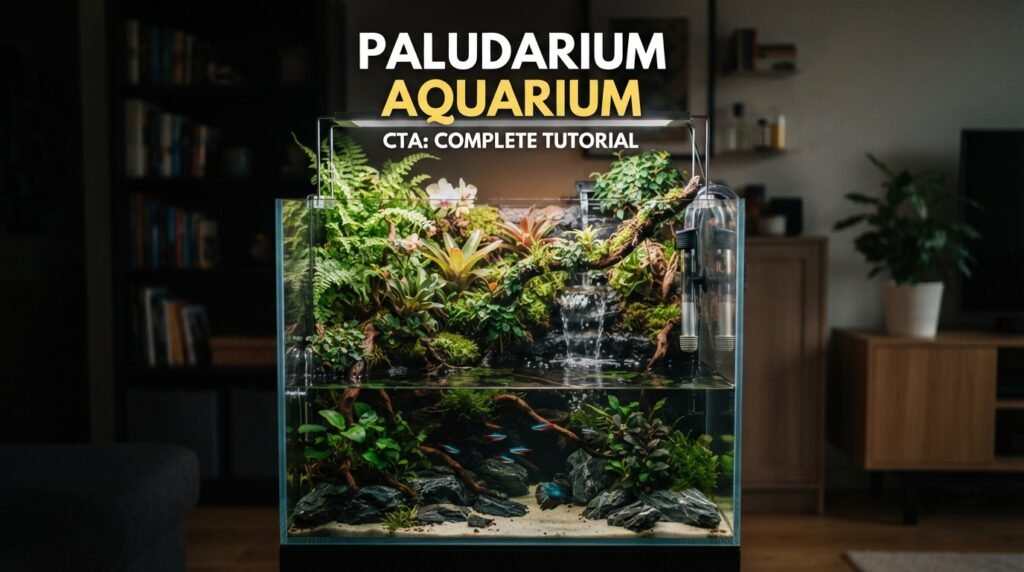
The biggest difference between a paludarium and a conventional aquarium is the number of environments inside the enclosure.
A traditional aquarium is primarily designed for aquatic organisms. Water fills most of the tank, and the hardscape and plants are arranged underwater.
A paludarium aquarium contains both aquatic and terrestrial areas. This means you have more opportunities to create height, depth, waterfalls, exposed roots, cliffs, and natural-looking shorelines.
| Feature | Traditional Aquarium | Paludarium Aquarium |
|---|---|---|
| Main environment | Aquatic | Aquatic and terrestrial |
| Water level | Usually high | Usually partial |
| Land section | None or very limited | Important part of design |
| Plant types | Mostly aquatic | Aquatic and terrestrial |
| Humidity | Moderate | Usually high |
| Waterfalls | Uncommon | Very common |
| Hardscape | Rocks and wood | Rocks, wood, cliffs and roots |
| Design possibilities | Underwater landscapes | Rainforests, streams, swamps and riverbanks |
| Maintenance | Primarily aquatic | Aquatic and terrestrial |
Why Build a Paludarium Aquarium?
There are many reasons people choose a paludarium aquarium instead of a traditional fish tank.
One of the biggest advantages is visual variety. A traditional aquarium is viewed primarily from the front and above, while a paludarium can have plants and hardscape extending vertically.
The land section can create a natural transition from underwater scenery to a terrestrial jungle. This makes the enclosure look more like a miniature piece of nature.
Another advantage is the opportunity to grow plants that cannot live completely underwater. Mosses, ferns, vines, and many tropical plants can thrive in the humid conditions of a well-designed paludarium.
A paludarium can also be a great learning project. You can observe how plants, water, microorganisms, and animals interact within a carefully maintained environment.
Popular Paludarium Aquarium Themes
Before building your enclosure, it helps to choose a specific theme. A theme makes it easier to select the right hardscape, plants, substrate, and animals.
Tropical Rainforest Paludarium
A tropical rainforest is one of the most popular paludarium designs. Use dense vegetation, moss-covered wood, rocks, roots, and a small pool of water to create the appearance of a humid jungle.
Tall plants can be placed toward the back while smaller plants and mosses occupy the foreground.
Riverbank Paludarium
A riverbank design recreates the edge of a tropical stream. The water section can run through the front or center of the enclosure, with rocks and exposed roots creating a natural shoreline.
This design works especially well with driftwood that extends from the water onto the land.
Waterfall Paludarium
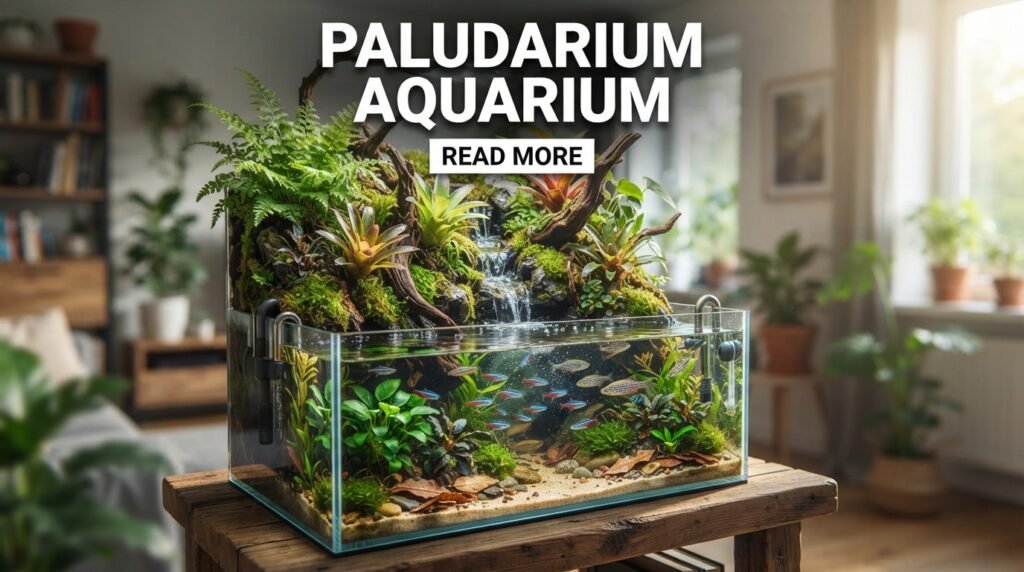
A waterfall can become the main focal point of a paludarium aquarium. Rocks are arranged vertically, and a small pump circulates water from the lower pool to the upper section.
Water then flows naturally back into the pool.
The waterfall should be tested carefully to make sure water does not escape the enclosure or continuously saturate areas that should remain only moderately moist.
Jungle Stream Paludarium
A jungle stream design combines a narrow flowing waterway with dense plants. Use small rocks, gravel, branches, and moss to make the stream look natural.
The stream can wind through the enclosure rather than running in a perfectly straight line.
Swamp-Style Paludarium
A swamp-style setup can feature shallow water, exposed roots, aquatic vegetation, moss, and partially submerged wood.
This style can have a darker and more mysterious appearance and works well with natural-looking brown and green materials.
Choosing the Right Tank
You can build a paludarium aquarium in several types of enclosures. A standard aquarium can be converted into a paludarium, although a taller enclosure can provide more opportunities for terrestrial plants and vertical hardscape.
The size should be based on your available space, budget, experience, and the animals you intend to keep.
A larger enclosure generally provides more room to create separate land and water areas. It also gives you more flexibility when arranging plants and hardscape.
For beginners, a modest-sized aquarium can be easier to manage than an extremely large project.
Planning the Land and Water Areas
Good planning is one of the most important parts of building a paludarium aquarium.
Start by deciding how much space should be occupied by water. Then determine the location and height of the land section.
You can create a simple shoreline, a raised island, multiple terraces, or a rocky cliff.
Think about the enclosure from the front before adding anything permanently. The hardscape should create depth rather than making the entire setup look flat.
A useful design principle is to place larger objects toward the back and smaller objects toward the front. This creates a stronger sense of scale.
Creating the Paludarium Hardscape
Hardscape forms the foundation of the entire design.
Common materials include aquarium-safe rocks, driftwood, branches, gravel, sand, and other materials suitable for aquatic environments.
Large rocks should be positioned securely because a collapsing structure can damage plants, equipment, or animals.
Driftwood can be especially useful because it naturally connects the aquatic and terrestrial sections. A branch rising out of the water can make the transition between the two environments look much more realistic.
Avoid creating unstable structures simply for appearance. Safety should always come before aesthetics.
Building the Land Section
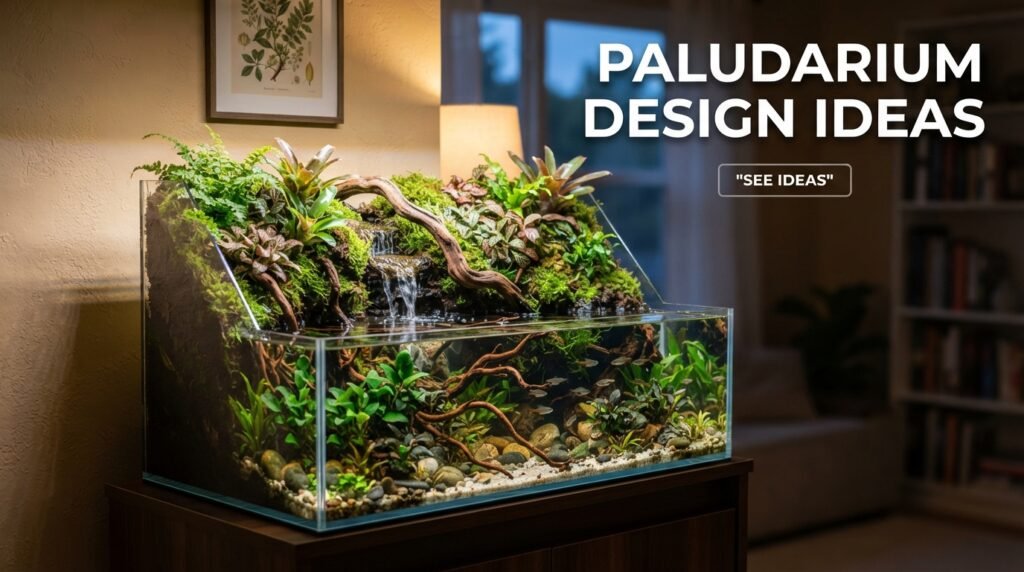
The land section can be created using various methods depending on the design.
Some setups use a raised platform or divider to separate the terrestrial area from the water. Others use rocks, wood, aquarium-safe structures, or specially designed backgrounds.
The land area needs appropriate drainage. If water becomes permanently trapped beneath the terrestrial substrate, it can create stagnant conditions and contribute to unpleasant odors, root problems, or mold.
A drainage layer can help separate excess water from the planting substrate.
Choosing Substrate
Substrate requirements are different for aquatic and terrestrial sections.
The aquatic section can use sand, gravel, aquasoil, or another aquarium-compatible substrate depending on the plants and animals being kept.
The land section generally requires a moisture-retaining but well-draining substrate. Tropical plants often benefit from an airy mixture that retains humidity without becoming completely waterlogged.
The exact substrate should be selected according to the plants you plan to grow.
Best Plants for a Paludarium Aquarium
Plants are one of the most important elements of a paludarium aquarium.
The best plants are those that tolerate high humidity and the specific conditions created by the enclosure.
Popular choices include:
- Java moss
- Christmas moss
- Java fern
- Anubias
- Bucephalandra
- Cryptocoryne
- Small tropical ferns
- Fittonia
- Peperomia
- Selaginella
- Pothos
- Various miniature creeping plants
Aquatic plants should be placed in the submerged area, while terrestrial plants should be planted above the waterline.
Some plants can tolerate having their roots in very wet conditions, but not every terrestrial plant can survive permanent submersion.
Using Moss in a Paludarium
Moss is particularly useful because it helps blend different parts of the hardscape together.
You can grow moss over rocks, driftwood, and other moist surfaces. As it develops, it can make artificial-looking structures appear much more natural.
Different mosses have different requirements, so research the specific species before adding them.
Avoid covering every surface with moss. Leaving some exposed rock and wood creates contrast and makes the design more visually interesting.
Lighting Requirements
Lighting is essential for plant growth.
A paludarium aquarium containing both aquatic and terrestrial plants should have lighting appropriate for the plants being grown.
LED aquarium lights are commonly used because they provide efficient illumination and produce relatively little heat compared with some older lighting technologies.
The lighting schedule should be consistent. Excessive lighting can encourage algae growth, while insufficient light can cause plants to become weak, pale, or elongated.
The ideal intensity depends on the plant species, enclosure height, water depth, and other factors.
Humidity and Ventilation
High humidity is one of the defining characteristics of many paludariums.
A closed or partially covered enclosure can naturally retain moisture. However, extremely high humidity combined with poor airflow can encourage mold and fungal problems.
Good ventilation is therefore important.
You want the enclosure to remain humid without becoming completely stagnant. Condensation on the glass is normal, but constant excessive condensation can indicate that airflow needs improvement.
Filtration in a Paludarium Aquarium
The aquatic section still needs appropriate biological filtration when it contains fish, shrimp, or other aquatic animals.
Depending on the design, you may use a small internal filter, sponge filter, canister filter, or another suitable filtration system.
The filter should be selected according to the volume of water rather than the total physical size of the enclosure.
A paludarium with only a small water pool may require very different filtration from one containing a large aquatic section.
Adding a Waterfall
A waterfall can dramatically improve the appearance of a paludarium aquarium.
To create one, water is typically pumped from the lower section to a higher point where it flows over rocks or another hardscape structure.
The pump should be powerful enough to provide the desired flow but not so powerful that water splashes outside the enclosure.
Before adding animals, test the waterfall for several hours or longer. Watch for leaks, excessive splashing, water accumulation, and areas where the flow is not behaving as expected.
Water Quality
Water quality remains important even when the aquarium is only partially filled.
If fish or shrimp are present, monitor parameters such as temperature, pH, ammonia, nitrite, and nitrate as appropriate for the species.
Regular partial water changes can help maintain healthy conditions.
Do not assume that a planted paludarium does not require water maintenance. Plants can help absorb nutrients, but they do not eliminate the need for responsible aquarium care.
Choosing Animals
Animal selection should come after the enclosure design rather than before it.
The animals must be compatible with the water volume, temperature, humidity, enclosure dimensions, and each other.
Small aquatic inhabitants may be appropriate for some designs. Shrimp and certain small fish can work in suitable aquatic sections, but the available swimming space must be considered carefully.
Some paludariums are specifically designed for amphibians or reptiles. These setups require specialized knowledge because terrestrial animals have specific environmental, dietary, and enclosure requirements.
Never overcrowd the enclosure simply because there appears to be available space.
Can You Keep Fish in a Paludarium Aquarium?
Yes, fish can be kept in some paludariums, but the aquatic section needs to provide enough water volume and swimming space for the chosen species.
Small fish are often easier to accommodate than large species.
You should also consider the height of the land section. If the water area is shallow, it may not be suitable for fish that require deeper swimming space.
The design should always be built around the needs of the animals rather than forcing animals into an unsuitable decorative setup.
Can You Keep Shrimp in a Paludarium?
Shrimp can be suitable for certain paludarium aquariums when the aquatic section provides stable water conditions and enough usable space.
Shrimp are sensitive to sudden changes in water parameters, so a mature and stable aquatic environment is preferable.
Plants, moss, rocks, and wood can provide surfaces for biofilm and hiding places.
However, always check the compatibility of shrimp with any fish or other animals you plan to keep.
Maintenance of a Paludarium Aquarium
A paludarium aquarium requires maintenance in both its aquatic and terrestrial sections.
Aquatic maintenance may include water changes, filter cleaning, algae management, and water testing.
Terrestrial maintenance can include trimming plants, removing dead leaves, controlling mold, cleaning glass, and maintaining appropriate moisture levels.
Waterfalls and pumps should also be checked regularly. Debris can reduce water flow and eventually clog equipment.
| Maintenance Task | Suggested Approach |
|---|---|
| Water testing | Regularly when aquatic animals are present |
| Water changes | Perform as needed based on water quality |
| Plant trimming | Remove excessive or unhealthy growth |
| Glass cleaning | Clean when algae or mineral deposits appear |
| Filter maintenance | Clean according to filter needs |
| Pump inspection | Check regularly for debris |
| Mold control | Improve airflow and remove affected material |
| Substrate care | Monitor for excessive waterlogging |
Common Paludarium Problems
One common problem is excessive moisture. While humidity is useful, constantly saturated terrestrial substrate can damage plant roots.
Another issue is mold. Mold can appear when organic materials remain wet with little airflow.
Algae may also develop in the aquatic section when lighting, nutrients, and maintenance are not balanced.
Water leakage is another concern, especially in complex waterfall designs.
The best solution is careful planning and regular observation. Small problems are much easier to correct before they become major problems.
How to Make a Paludarium Look Natural
A natural-looking paludarium does not require dozens of decorations.
Instead, focus on creating believable relationships between rocks, wood, plants, and water.
Avoid placing every object symmetrically. Nature is irregular.
Use different sizes of rocks and branches. Allow some plants to grow naturally while keeping others trimmed.
Create depth by using taller hardscape toward the back and smaller elements toward the foreground.
Most importantly, create a convincing transition between land and water.
Paludarium Aquarium for Beginners
A beginner-friendly paludarium does not need a waterfall, dozens of plant species, or complicated equipment.
Start with a simple enclosure containing a small aquatic section and a raised terrestrial area.
Use easy plants such as mosses, hardy aquatic plants, and humidity-tolerant terrestrial plants.
Keep the animal population minimal or allow the planted environment to establish before adding livestock.
Starting small gives you an opportunity to learn how humidity, lighting, water quality, plant growth, and maintenance interact.
Is a Paludarium Aquarium Difficult to Maintain?
A paludarium is generally more complicated than a basic aquarium because it combines multiple environments.
However, complexity depends heavily on the design.
A simple planted paludarium can be relatively easy to maintain. A large enclosure with a waterfall, many plant species, fish, amphibians, automated misting, and complicated drainage can require significantly more work.
For beginners, simplicity is usually the better approach.
How Long Does It Take for a Paludarium to Mature?
A newly built paludarium aquarium may look attractive immediately, but it usually takes time for the plants and ecosystem to mature.
Mosses need time to spread. Terrestrial plants need time to establish roots. Aquatic plants may take weeks or months to reach their desired appearance.
As plants grow, the hardscape becomes increasingly integrated with the landscape.
This gradual development is part of the appeal of maintaining a paludarium.
Final Thoughts
A paludarium aquarium combines the beauty of an aquarium with the lush appearance of a miniature terrestrial landscape. It can recreate everything from a tropical rainforest and jungle stream to a rocky riverbank or peaceful swamp.
The most successful setups begin with careful planning. Decide where the land and water will be located, choose stable hardscape, provide appropriate drainage, select plants according to their growing conditions, and install suitable lighting and filtration.
If you plan to keep animals, design the enclosure around their needs first. Water quality, temperature, space, humidity, compatibility, and long-term care should always take priority over appearance.
Whether you are an experienced aquascaper or a beginner looking for a new project, a paludarium aquarium offers almost unlimited opportunities for creativity. With patience and regular maintenance, a simple glass enclosure can gradually develop into a living miniature landscape that changes and grows over time.
Frequently Asked Questions About Paludarium Aquarium
What is a paludarium aquarium?
A paludarium aquarium is an enclosure that combines aquatic and terrestrial environments. It normally contains a water section and a land section with plants, rocks, wood, and sometimes animals.
Is a paludarium better than an aquarium?
Neither is universally better. A traditional aquarium is usually simpler if your primary goal is keeping aquatic animals. A paludarium offers greater design variety because it combines land and water.
Can you put fish in a paludarium?
Yes, provided the aquatic section is large and deep enough for the selected fish and the water parameters are appropriate.
Can shrimp live in a paludarium?
Shrimp can live in suitable paludariums when the aquatic section provides stable water conditions, adequate space, hiding places, and compatible tankmates.
Do paludariums need filters?
A filter may be necessary when the aquatic section contains fish or other animals. The appropriate filtration depends on water volume and stocking.
Do paludariums need a lid?
Many paludariums benefit from a lid because it helps maintain humidity and prevents excessive evaporation. However, some ventilation should usually be provided depending on the plants and animals.
Do paludariums need CO2?
Not necessarily. Many plants can grow successfully without injected CO2. CO2 can be useful for certain aquatic plants, but it is not automatically required for every paludarium.
How often should a paludarium be cleaned?
Maintenance frequency depends on the design and inhabitants. Remove dead leaves and debris regularly, maintain the aquatic filtration system, clean the glass when necessary, and perform water changes based on water quality.
Can you make a paludarium without a waterfall?
Yes. A waterfall is completely optional. A simple shoreline, pond, stream, or still-water design can look just as attractive.
What plants are best for a paludarium aquarium?
Mosses, ferns, Fittonia, Peperomia, Selaginella, Pothos, Anubias, Java fern, Bucephalandra, and other humidity-tolerant plants can be suitable depending on whether they are grown above or below the waterline.
Can a paludarium be self-sustaining?
Some heavily planted paludariums can become relatively stable ecosystems, but they should not be assumed to be completely self-sustaining. Water quality, plant growth, humidity, filtration, and animal health still need monitoring.
How much water should a paludarium have?
There is no single correct water-to-land ratio. The amount depends on the desired design and the needs of the plants and animals. Some paludariums are mostly aquatic, while others have only a small pool or stream.
Is a paludarium aquarium good for beginners?
Yes, if the design is kept simple. Beginners should start with hardy plants, a straightforward land-water layout, stable equipment, and minimal livestock.
What is the main benefit of a paludarium aquarium?
The biggest benefit is the ability to combine aquatic and terrestrial scenery in one living landscape. This creates more vertical depth and design possibilities than a conventional aquarium.