
 By admin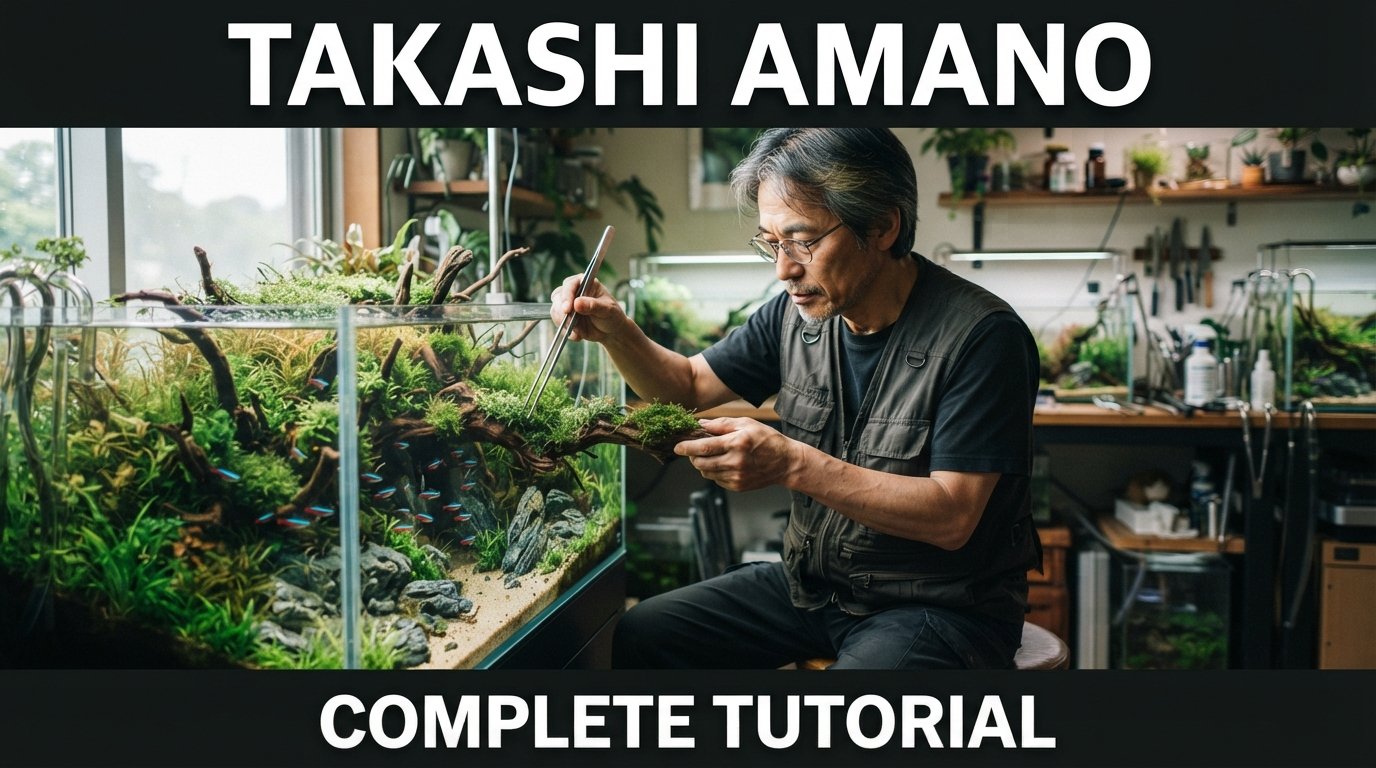
Takashi Amano aquascaping is one of the most influential styles in the world of planted aquariums. Inspired by natural landscapes, this approach combines aquatic plants, rocks, driftwood, substrate, water, and carefully planned composition to create underwater scenes that resemble forests, mountains, valleys, and other natural environments.
Takashi Amano was a Japanese aquarist, photographer, designer, and founder of Aqua Design Amano. His approach helped popularize the idea that an aquarium could be more than a container for fish and plants. It could become a miniature landscape designed with the same attention to balance, proportion, depth, and natural beauty found in traditional landscape art.
Today, aquascapers around the world continue to use principles associated with Amano’s work when creating planted aquariums. His influence can be seen in Nature Aquarium layouts, Iwagumi-inspired compositions, carefully arranged driftwood, dense aquatic planting, and the use of negative space.
What Is Takashi Amano Aquascaping?
Takashi Amano aquascaping refers to an approach to aquarium design inspired by the natural landscapes and composition principles associated with Takashi Amano.
The goal is not simply to place attractive decorations inside a tank. Instead, the aquascaper creates a complete underwater landscape where every element has a purpose.
Rocks can represent mountains, driftwood can suggest fallen trees or forest structures, plants can represent vegetation, and open substrate can become a path, valley, riverbank, or clearing.
The aquarium should appear natural rather than artificially symmetrical.
Who Was Takashi Amano?
Takashi Amano became internationally recognized for his work with planted aquariums and nature photography. His aquarium designs were strongly influenced by his observations of natural environments.
His approach emphasized simplicity, natural proportions, depth, and careful composition.
He also helped establish the Nature Aquarium concept through Aqua Design Amano and related publications and exhibitions. His work introduced many aquarium keepers to a more artistic approach to planted aquariums.
One of the most important ideas associated with his work is that an aquarium should capture the feeling of nature rather than simply reproduce individual objects from nature.
Main Principles of Takashi Amano Aquascaping
Several principles are especially important when creating an Amano-inspired aquascape.
These include natural composition, asymmetry, proportion, depth, negative space, careful hardscape placement, appropriate plant selection, and a clear focal point.
The goal is to make all of these elements work together instead of allowing one feature to dominate unnecessarily.
Popular Takashi Amano Aquascaping Styles
| Style | Main Features | Visual Effect |
|---|---|---|
| Nature Aquarium | Plants, rocks, wood, natural composition | Natural landscape |
| Iwagumi | Carefully arranged stones | Mountain scenery |
| Forest Style | Driftwood and dense plants | Underwater forest |
| Island Style | Hardscape surrounded by plants | Strong focal point |
| Valley Style | Open space between hardscape | Depth and perspective |
| River Style | Sand path and flowing composition | Natural waterway |
| Jungle Style | Dense and layered planting | Wild landscape |
| Minimalist Nature | Limited elements and open space | Calm and simple |
The Nature Aquarium Concept
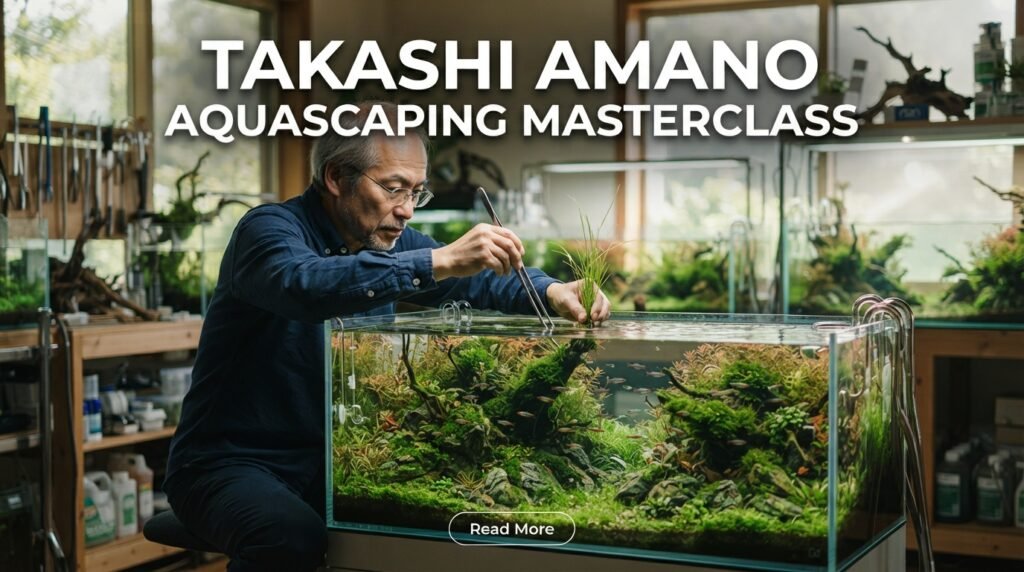
The Nature Aquarium concept is one of the most recognizable ideas associated with Amano-style aquascaping.
Instead of designing an aquarium around artificial ornaments, the aquascaper uses natural materials and plants to create a miniature landscape.
A Nature Aquarium may resemble a forest, mountain valley, rocky hillside, or open field.
The fish are generally not the only visual focus. They become part of the overall ecosystem and landscape.
The Importance of Natural Composition
Composition is one of the most important parts of Takashi Amano aquascaping.
Before adding plants, think about where the viewer’s eye should travel.
A strong composition often begins with one dominant feature, such as a large stone, group of rocks, or piece of driftwood.
Supporting elements then create a transition toward smaller features.
This gives the aquarium a visual hierarchy instead of making every object equally noticeable.
Asymmetry in Amano Aquascaping
Natural landscapes rarely have perfect symmetry.
For this reason, Amano-inspired aquascapes commonly avoid placing the largest object directly in the center.
Instead, the main focal point can be positioned slightly to one side, with smaller elements balancing the opposite area.
This creates tension and visual interest while still maintaining overall balance.
The Rule of Thirds
The rule of thirds can be useful when planning an Amano-style aquarium.
Imagine dividing the aquarium horizontally and vertically into three sections.
The main focal point can be placed near one of the intersections rather than directly in the center.
This does not have to be followed perfectly. It is simply a useful planning tool for creating balanced compositions.
Choosing the Main Hardscape
Hardscape is the foundation of the aquascape.
Common materials include rocks and aquarium-safe driftwood.
Choose one main material to establish the visual character of the aquarium. For example, a rocky Iwagumi composition will feel very different from a wood-based forest layout.
The main hardscape should be selected before adding most of the plants.
Amano-Style Rocks
Rocks are extremely important in many Nature Aquarium designs.
A primary stone can act as the focal point while smaller stones support it.
Try to keep the rock type consistent. Using stones with similar colors, textures, and geological appearance usually creates a more natural composition.
Avoid arranging rocks so that every stone faces exactly the same direction. Natural variation makes the landscape more convincing.
Creating an Iwagumi Aquascape
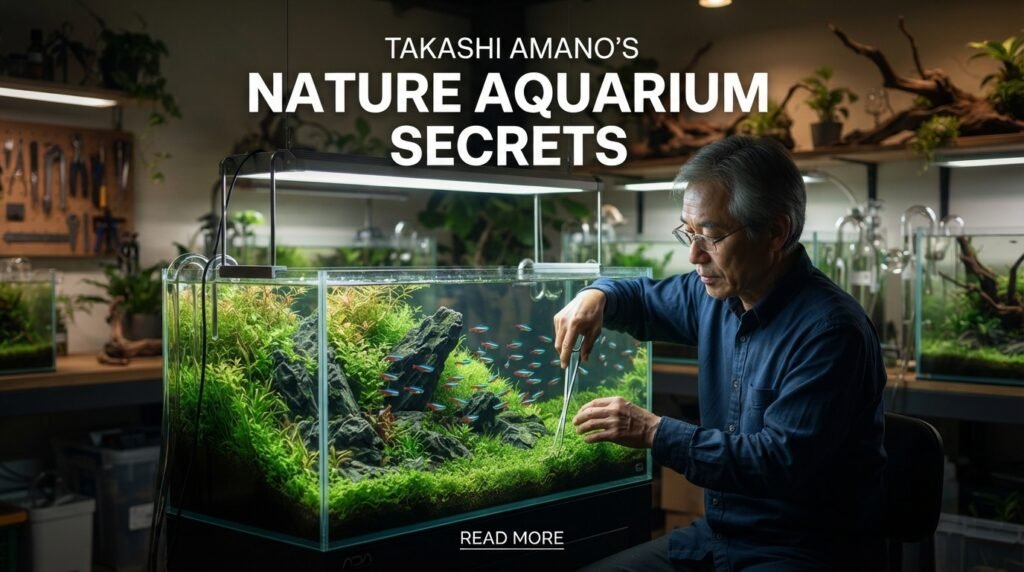
Iwagumi is a stone-focused aquascaping style commonly associated with Nature Aquarium design.
A traditional composition often uses several stones arranged according to visual hierarchy.
The largest stone becomes the primary focal point, while secondary stones provide balance and rhythm.
Low-growing plants are often used so that the stones remain visually dominant.
An Iwagumi aquarium may look simple, but achieving a convincing composition requires careful attention to stone placement.
Driftwood in Amano Aquascaping
Driftwood can represent trees, roots, branches, or fallen woodland structures.
Branching wood is particularly useful for forest-inspired designs.
Rather than placing a single piece randomly, consider how the branches interact with the surrounding rocks and plants.
The wood should appear to grow naturally from the landscape rather than looking like an isolated decoration.
Creating a Forest-Style Aquascape
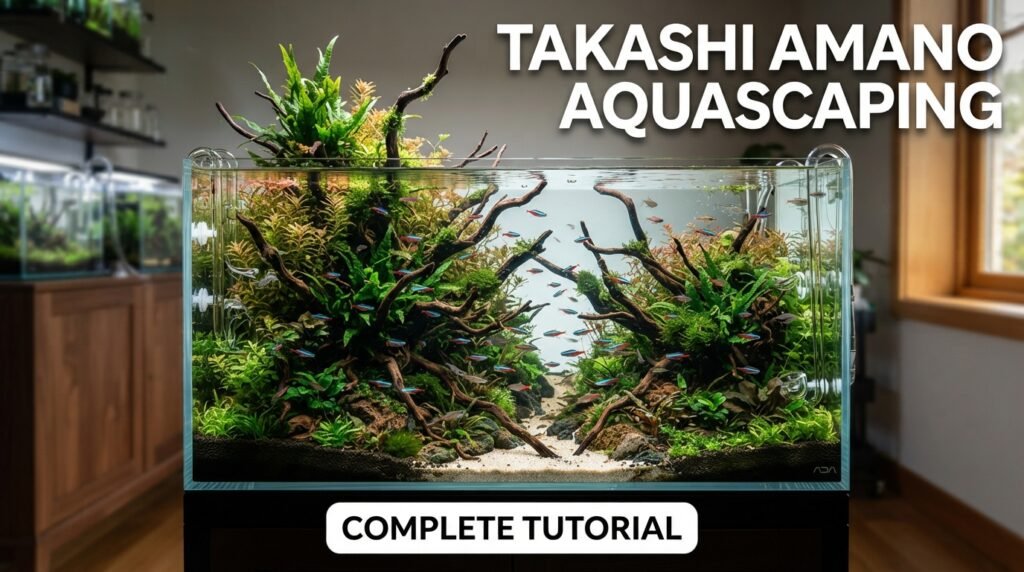
A forest-inspired Amano aquascape can use branching driftwood as the main structure.
Attach moss or small plants to selected branches while using taller plants behind and around the wood.
The branches can create vertical lines that resemble tree trunks.
Leave open areas between some branches to create depth and prevent the aquarium from looking like a solid wall of vegetation.
Creating Depth in an Amano Aquascape
Depth is one of the defining characteristics of a successful natural aquascape.
There are several ways to create it.
Use larger hardscape elements toward the front and smaller elements toward the back.
Use gradually smaller plants as the composition moves into the distance.
A curved sand path can also lead toward the background and create a strong sense of perspective.
Using Negative Space
Negative space refers to areas intentionally left open.
In Amano-inspired aquascaping, empty space is not wasted space.
An open sand area can represent a river, path, valley, or clearing.
It also provides visual breathing room around the focal point.
Without negative space, the aquarium can become crowded and lose the sense of scale that makes natural aquascaping attractive.
Choosing Plants for Amano Aquascaping
Plant selection should support the landscape rather than distract from it.
Commonly useful plants include:
- Java moss
- Christmas moss
- Anubias
- Java fern
- Cryptocoryne
- Rotala
- Hygrophila
- Amazon sword
- Dwarf hairgrass
- Monte Carlo
- Glossostigma
- Bucephalandra
The appropriate choices depend on the aquarium’s lighting, substrate, nutrients, CO2 availability, and maintenance routine.
Foreground Plants
Foreground plants remain relatively short and create the visual foundation of the aquascape.
Carpeting plants can create the appearance of grass or a miniature meadow.
Monte Carlo and dwarf hairgrass are commonly considered for this purpose, depending on the aquarium conditions.
The foreground should not necessarily be completely covered. Leaving some substrate visible can improve depth and contrast.
Midground Plants
Midground plants help connect the foreground to taller background vegetation.
Cryptocoryne, smaller Anubias, Bucephalandra, and other compact plants can work well in this area.
The goal is to create a gradual transition rather than an abrupt change in plant height.
Background Plants
Tall plants can create the appearance of distant vegetation.
Stem plants are particularly useful for creating background density.
Planting groups of the same species can produce a more organized and natural appearance than randomly mixing many different plants.
Planting in Groups
A common aquascaping mistake is placing one plant of every available species throughout the aquarium.
Amanos-inspired layouts often look more cohesive when plants are grouped.
For example, one area may contain a dense group of stem plants while another contains a carpet.
Repeating the same plant in multiple locations can also connect different areas of the composition.
Substrate and Slopes
Substrate is not simply a base for plants.
It can also help create perspective.
A higher substrate level toward the back of the aquarium can make the landscape appear deeper.
You can create slopes around rocks and driftwood, then allow the substrate to gradually become lower toward the foreground.
The slope should be stable so it does not collapse over time.
Sand Paths
A sand path can become one of the most effective visual tools in an Amano-style aquascape.
The path can start wide in the foreground and gradually become narrower toward the background.
This creates the optical illusion of distance.
A curved path can appear more natural than a perfectly straight one.
Small stones or plants can be placed along its edges to integrate the path with the surrounding landscape.
Lighting for Amano Aquascaping
Lighting should support healthy plant growth and showcase the composition.
The correct intensity depends on the plants being grown.
High-demand carpeting plants may require stronger lighting than low-light species.
Lighting duration should also be controlled to reduce the risk of excessive algae.
The goal is healthy plant growth rather than simply using the strongest possible light.
CO2 in Nature Aquarium Layouts
CO2 can be particularly useful in heavily planted aquascapes.
It can support faster plant growth and help demanding carpeting plants establish.
However, not every Amano-inspired aquarium needs injected CO2.
A low-tech design using plants such as Anubias, Java fern, moss, and some Cryptocoryne can be created with simpler equipment.
The plant selection should match the available equipment and maintenance level.
Choosing Fish for an Amano Aquascape
Fish should complement the scale and style of the aquarium.
Small schooling fish can create movement through open areas without overwhelming a carefully designed landscape.
Shrimp can also work well in planted aquariums and add activity among rocks, moss, and plants.
The livestock should always be selected based on the aquarium’s size, water conditions, compatibility, and care requirements.
Schooling Fish and Aquascape Movement
Small schooling fish can add another visual dimension.
When they move through open areas, they create a sense of scale that can make the aquarium look larger.
Avoid overcrowding the aquarium simply for visual effect. The stocking level should remain appropriate for the aquarium and filtration system.
Shrimp in Amano-Style Aquascaping
Shrimp can be excellent inhabitants for planted aquascapes.
They spend much of their time exploring plants, rocks, substrate, and hardscape.
Moss-covered surfaces can provide additional grazing areas.
A shrimp-focused Nature Aquarium can be particularly attractive when the hardscape remains visible and the plants create a dense but controlled background.
Small Amano Aquascaping Ideas
A small aquarium can still capture the principles of Amano-style design.
Use one strong focal point rather than several large decorations.
A small rock arrangement, a compact piece of driftwood, a simple carpet, and a few background plants can create an effective composition.
Keep the plant scale appropriate for the aquarium.
Large Amano Aquascaping Ideas
Large aquariums provide more space for complex landscapes.
You can create large valleys, forests, mountain scenes, or river-inspired layouts.
Large pieces of driftwood can become the foundation of a forest, while multiple groups of rocks can create a mountain range.
Use perspective carefully so that the composition remains visually connected from foreground to background.
Common Takashi Amano Aquascaping Mistakes
One of the most common mistakes is trying to copy a famous aquascape exactly.
The goal is to understand the principles rather than reproduce someone else’s aquarium.
Another mistake is using too many different materials.
An aquarium can also become overcrowded with plants if there is no negative space.
Poor proportion is another issue. Oversized rocks or plants can make a small aquarium look unnatural.
Finally, many beginners focus heavily on the initial appearance and forget that plants will grow. Always design with the mature aquarium in mind.
How to Build a Takashi Amano-Inspired Aquascape
Start by selecting the aquarium and deciding what type of natural landscape you want to represent.
Choose the main hardscape and experiment with different positions before adding substrate.
Establish the main focal point first.
Add supporting rocks or wood while maintaining asymmetry.
Create a substrate slope to increase depth.
Add your foreground plants first, followed by midground and background plants.
Leave intentional open space.
Fill the aquarium carefully and begin the cycling and establishment process appropriate for the setup.
As the plants grow, trim them to maintain the original composition.
Maintaining an Amano-Style Aquarium
An Amano-inspired aquarium requires regular maintenance if you want to preserve its original composition.
Trim stem plants before they become too dense.
Keep carpeting plants at an appropriate height.
Remove damaged leaves and clean algae when necessary.
Perform appropriate water changes and maintain filtration.
As plants grow, regularly compare the aquarium to your original composition. If one area becomes too dominant, trim or replant it.
Maintenance is not about preventing growth. It is about guiding growth.
How to Make an Aquascape Look More Natural
Avoid perfectly straight lines and identical spacing.
Use gradual transitions between different plant heights.
Allow some irregularity in rocks and wood.
Repeat textures and plants so different areas feel connected.
Most importantly, think about the natural landscape you are trying to represent.
If the aquarium has a clear environmental idea, individual design decisions become easier.
Takashi Amano Aquascaping vs Traditional Aquarium Decoration
Traditional aquarium decoration often focuses on individual objects such as ornaments, artificial plants, or decorative structures.
Amano-style aquascaping instead focuses on the relationship between elements.
The rocks, plants, wood, substrate, fish, and open areas work together to form one landscape.
This difference is what gives the Nature Aquarium approach its distinctive appearance.
Final Thoughts
Takashi Amano aquascaping changed the way many aquarium enthusiasts think about planted tanks. His approach demonstrated that an aquarium could be treated as a miniature landscape where composition, proportion, depth, plants, hardscape, and negative space work together.
The most important lesson is not to copy a particular aquarium. Instead, focus on the principles behind natural composition.
Choose a clear focal point, use high-quality hardscape, create depth with substrate and plant placement, leave intentional open areas, and allow plants to develop naturally.
Whether you are creating a small Iwagumi aquarium, a moss-covered forest, a large Nature Aquarium, or a simple planted layout, these principles can help you create a more balanced and natural underwater landscape.
Frequently Asked Questions
What is Takashi Amano aquascaping?
Takashi Amano aquascaping is an approach to aquarium design inspired by Takashi Amano’s Nature Aquarium philosophy and natural landscape compositions. It emphasizes plants, rocks, driftwood, depth, balance, and natural-looking arrangements.
What is the Nature Aquarium style?
The Nature Aquarium style uses natural materials and aquatic plants to recreate the feeling of terrestrial landscapes underwater, such as forests, mountains, valleys, and rivers.
What plants are commonly used in Amano-style aquascaping?
Mosses, carpeting plants, stem plants, Anubias, Java fern, Cryptocoryne, Bucephalandra, and other aquatic plants can be used depending on the design and aquarium conditions.
What is Iwagumi aquascaping?
Iwagumi is a stone-focused aquascaping style that uses carefully arranged rocks as the primary structural elements, usually supported by low-growing plants.
Does Amano aquascaping require CO2?
No. CO2 is not mandatory for every Amano-inspired aquarium. However, it can be useful for demanding plants and high-growth planted layouts.
What rocks are best for Amano aquascaping?
The best rock depends on the design. Choose aquarium-safe rocks with natural shapes and a consistent color and texture that complement the rest of the hardscape.
How do you create depth in an Amano aquascape?
Depth can be created with substrate slopes, smaller hardscape toward the background, layered plant heights, open space, and narrowing sand paths.
Why is negative space important in aquascaping?
Negative space gives the composition visual breathing room and can make the aquarium appear larger. It can also represent natural features such as rivers, paths, valleys, or clearings.
Can beginners create a Takashi Amano-style aquarium?
Yes. Beginners can start with a simple composition using easy plants, a few rocks or one piece of driftwood, and a clear focal point.
What fish work well in a Nature Aquarium?
Small schooling fish, appropriate shrimp, and other compatible aquarium inhabitants can complement a Nature Aquarium. Stocking should always be based on aquarium size, water conditions, and species compatibility.
How often should an Amano aquascape be trimmed?
The frequency depends on plant growth. Fast-growing plants may require frequent trimming, while slow-growing plants such as Anubias and some mosses require less frequent maintenance.
What is the most important part of Amano aquascaping?
Composition is one of the most important parts. A strong relationship between hardscape, plants, negative space, proportion, and depth helps the aquarium look like one complete landscape rather than a collection of decorations.